Sex, Drugs, and Public Health

May 3, 2016

Dog Food Medicine

Filed under: Uncategorized — cbmosher @ 10:21 am

images

 
Pierre calls 911 for an ambulance every week or two during the warm months when he still pans for gold. More often during the lonely winter.

“Chest pain,” he’ll wheeze the magic words. “Like a fart turned sideways.”

Just to seal it, he’ll often add “I can’t drive.”

We wouldn’t want him to. Not any time after eleven A.M. anyway. There are enough drunks on the roads during the night hours causing accidents; we don’t want the steel mining contraptions crammed into his rusty Datsun clanging into each other and shifting the wreck’s momentum as it staggers between the right lane and its usual trajectory directly into oncoming daytime traffic.

“We’re coming, Pierre,” we always reassure him.

It’s my job to bring the dog food.

Red lights plinking off the pine trees astride the road, siren wailing to warn any meandering deer, Joe, the hospital janitor, weaves around the hills and swoops us down, then up the gullies. Like a needle embroidering the landscape.

As the ambulance struggles up the final grade to Pierre’s shack on the hill, transmission slipping, medical equipment sliding to the back of the vehicle, I pull an opener from the Trauma Kit and start opening the first can. I’ve ruined a few pairs of pants from that splattered grease.

The instant we pull into the junkyard surrounding his shack, the ambulance is accosted by a half dozen raucous canines, no two of which look to be even the same species, let alone the same breed, but all of which are seriously mean and, we’re pretty sure, unvaccinated.

I roll down the window. A big black-and-brown with stinking breath and thistle-matted fur lunges his front paws onto the door, almost reaching the window. His snarling makes my ears ring.

“Ready?” I yell to Joe.

“Ready.”

I wind up, like back in Little League, and heave the can as far as possible from both ambulance and front door of the shack.

The howling, yelping, baying cacophony streaks after the can. We jump out, run to the back of the ambulance, yank out the gurney, and run for the shack.

“Got the Trauma Kit?” he asks me.

I streak back to the ambulance, grab the kit, then race toward the shack again. The black-and-brown sees me, and comes charging. We burst in, hauling the gurney and Trauma Kit, and slam the door behind us.

“What took ya so long?” he growls from somewhere within his indoor junkyard. “My friends are saying nice things about me – I must be ready to die.”

The din of dogs is a muffled tornado beyond the thin walls. We can slow down now, and be methodical.

I check his blood pressure.

“Never mind that,” his tobacco breath gargles. “Check my eyes. I don’t wanna go blind from that Immaculate Degeneration, like my brother.”

“I thought you had chest pain,” I retort.

“Yeah. It’s prob’ly from the cigars the doctor said I had.”

I’m surprised.

“You smoke? I thought you just chewed,” I try hard – in vain – not to look at the permanent brown streak of stained skin at the right corner of his mouth.

“Don’t smoke,” he mumbles. “Doctor said the X-ray showed I have cigars in my lungs.”

I listen to him breathe, stretching the stethoscope to its full distance. That close to him, I don’t want to inhale too deeply.

“There’s some mucus in your lungs. You coughing it out?”

“Can’t. I can get down to my cough, but I can’t get under it. It’s stuck. Take me to the hospital.”

We will, of course. But by the time he’s strapped securely into the gurney and we’re ready, a dozen paws scrape furiously at the door. The incessant caterwauling envelopes us.

I pull the second can from the Trauma Kit, open it, crack the door just enough, and heave again.

They all wheel and run after it. All but the black-and-brown. He stands there, snarling at me, saliva drooling from his black lips like tobacco juice from an old miner’s mouth. But then he, too, turns to chase the pack, sure of himself that he’ll get the biggest share.

We run for the ambulance, wheels bumping over the irregular earth and the scattered trash.

“Hey, slow down,” Pierre complains. “It feels like you done throwed me in the ore tumbler.”

We shove him in the back and lock the gurney in place. We just make it to our seats before the dogs come back, snarling for more.

“Don’t you feed your dogs?” Joe shouts back to Pierre once we’re safe inside.

I shiver at the sound of claws scraping down the vehicle like fingernails on my grade school blackboard.

“Sure I feed ‘em,” he yells up to the driver. “I feed ‘em ambulance guys.”

And he chuckles all the way down the hill as our red light strums the pines that straddle the road.
March 9, 2016

Filed under: Uncategorized — cbmosher @ 5:44 am

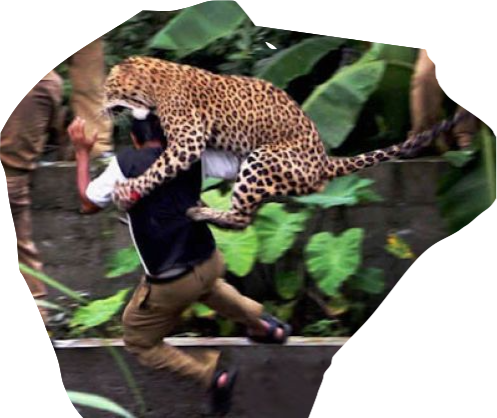
perfectly-timed-pics-moments-disaster-part8-14

So, I’m standing in line at the local 24 hour Stop-and-Rob, waiting behind some gum-snapping teenager to pay for my food-like products. Stuff not recommended by any Public Health officials. But I figure, if anyone asks, I can say they’re not for me and go to confession later.

Then I feel someone behind me. Not that he touches me or breathes on me, but he’s giving off a very strong – – – presence.

“Hey, Bobbie,” yells the check-out clerk over the teen-ager’s head and mine. “How you been?”

“Still alive,” the guy responds with a voice like an animal’s growl.

I’m about to turn around and be friendly, trapped as I am between the trajectories of their words. Until he finishes his thought: “no thanks to the damn DOCTORS.” He spits the last word.

He starts moving toward the counter, coming alongside me, talking directly to the counter clerk. “Doctors don’t know SHIT.”

I see him with my peripheral vision. Scruffy three-days’ beard, saliva still glistening on his lips from the words he’s spitting, his eyes narrow and predatory.

Like a snake’s.

A fog of alcohol fumes moves with him.

“DOCTORS gave my mother pills,” he seethes thru clenched teeth.

Ah. That’s what I felt when he was behind me: violence, barely contained.

“Take them pills, they said. You’ll be fine, they said.” His lips stretched out the “f” in “fine” until it sounded like a burning fuse.

It’s clear that his words and his hatred are aimed at me, but his eyes, like mine, remain fixed on the check-out clerk.

Who is his mother? Is she my patient? Or, was she?

The teenager in front is taking forever to fish out and count her nickels and pennies.

“Doctors HURT people,” the alcohol cloud blasts me again. I don’t even allow him into my peripheral vision anymore.

Maybe I should just go.

“Doctors should be KILLED.”

The teenager finally turns to leave.

“Just this,” I hold up the candy bar and can of Cheese-Whiz. I don’t want to put them on the counter, prolonging the process.

Wonder if Cheese-Whiz could function like Mace?

I give the clerk three bills and leave without my change. All the way to the door, I feel a laser boring a smoldering hole into the back of my cranium.

The door swings closed behind me, and I’m back in the community again. The community where almost everyone knows me. The community I serve. Trying to do well for everyone who comes for help. And I succeed most of the time.

But, in this business, most of the time isn’t good enuf.

January 27, 2016

The Next Big Public Health Epidemic

Filed under: Uncategorized — cbmosher @ 11:00 am

Among the on-going challenges of contaminated water, cases of communicable disease, and various Public Health emergencies, I’ve noticed a larger pattern. Almost every decade, some major Public Health problem grows into an epidemic that plagues us for years. So, what’s coming next?


DSC_0429

                                                                                                                   (photo by Sarah Mosher)


In the early 1980’s after I’d returned from South America, a patient walked into a doctor’s office, terrified that he had melanoma. He was young – too young for a fatal disease, he told his doctor – just 27. But these spots on my skin – – –

The doctor, after examining him, was reassuring. Doesn’t look like melanoma. A biopsy will tell us.

It turned out to be Kaposi’s sarcoma. A disease I’d heard of – once – in Med School, but never seen. Not even in towering teaching hospitals in New York City or Los Angeles. My 2400 page textbook of Medicine mentioned it just once, in only eighteen words, within a table of multiple other obscure skin conditions. It was endemic to Africa, but exceedingly rare in the U.S.

Or had been, up until the 1980’s.

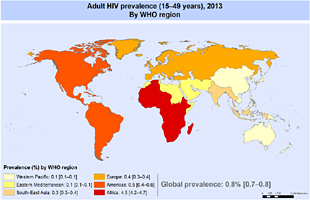
AIDS soon erupted into the number one Public Health epidemic in the U.S. and, quickly, in much of the rest of the world. Jet travel accelerated this disease’s spread, unlike the inevitable but slower spread of Tuberculosis or Syphilis – both major Public Health epidemics in prior centuries.

hiv_013_thumb


It’s not much in the news anymore. The non-journalistic reasons include discovery of some very good suppressant drugs and an impressively effective Public Health education effort.

So what is the most likely candidate as the next major epidemic which Public Health physicians and other professionals will be combatting for a decade or two?

Just as AIDS was the underlying condition which spawned outbreaks of Kaposi’s, of unusual lymphomas, and of uncontrolled invasion by microbes previously classified as “benign,” Climate Change will spawn multiple Public Health outbreaks.

Think of Climate Change as the growing epidemic of the 2016 – 2036 decades. What health problems will spring from it?

1. As the planet warms, mosquitoes, ticks and other insect vectors can expand their territories to the north (2015 was the hottest year, planet-wide, since we began keeping records 136 years ago. It quickly surpassed what is now the second-hottest year – 2014).

aedes_aegypti.jpg.size.xxlarge.letterbox


As the vectors move north, and travellers to tropical vacation spots return home during some virus’ infectious period, the potential for spread of seldom or never seen diseases increases at these latitudes.

For example, Lyme-infected ticks have been increasing in numbers and have been found further north in Canada. Species of the Aedes mosquito which can carry Yellow Fever, Dengue, Chikengunya and now, Zika viruses have been found in the southern U.S. Some species of Aedes have been found as far west as California and as far north as New York.

*Chikengunya, originally of Africa, spread to the Caribbean, right next door, in 2013. Within a year, it had hit the U.S.

*Dengue, originally of the Caribbean, showed up in Texas in 2004 and Florida in 2009.

*Zika virus, originally of Africa and Brazil, is already in northern Mexico. As of January 20, there have been a dozen imported cases of Zika in the U.S..

Are all these diseases certain to become established in the U.S.? Nothing is certain in Medicine. But now, because of Climate Change, it is very possible.

2. Other than these arthropod-borne diseases, other Climate Change triggered Public Health problems will be Emergencies caused by Extreme Weather events (earlier and more powerful hurricanes, floods, heat waves, fires, drought).

IMG_0806

                                       (drought and beetle-killed trees in Mariposa, Calif)


3. Also, we anticipate more frequent and severe Air Pollution emergencies from increased smog, more pollen allergens, and smoke from fires.


What can you do?

1 Start acclimating and adapting. Stop hiding in the AC on a daily basis. Use the AC only when really necessary (the hottest summer days), and set it higher than 68 – like 80.

2 Install Solar panels and house batteries to run the house and you don’t have to worry about power outages.

3 Start conserving water. Catch rain water and reuse greywater.

4 Eliminate mosquito breeding areas around your home including old tires, birdbaths, pails and other containers and flower pots outside your home.


And for the Visionaries and Leaders among you, do what is necessary to get us all off fossil-fuels and on renewable sources as quickly as possible.

The Health of the Public (which includes you and your children) depends on us taking action.

December 15, 2015

Harvesting Currier & Ives

Filed under: Uncategorized — cbmosher @ 5:16 pm

1453405_771045859590890_976661838_n


The anemic sun, unimpeded by even a single cloud, illuminated a white world beyond my frosted window. Snow still covered our hills, muffling everything to the hush of a church. We kids were growing weary of struggling into layers of thick clothes, just to venture out. Anyway, it was too cold to do anything outdoors. But stuck indoors was even more boring.

The phone rang.

“Hey, Jimmy from up the road is asking if we want to go with him to help harvest maple syrup.”

A trip to the grocery store? I wondered

Jimmy’s dad dropped us from his pickup truck into snow so cold it squeaked when our boots hit it. Even at this temperature, the smell of cow manure wafted from the pickup’s bed.

“I’ll pick you boys up in a couple of hours,” the kid’s dad said. Then he was gone in a cloud of snow.

I looked around. Just the typical wood-sided farmhouse, much bigger barn, and multiple tractor implements dormant in the yard beneath mounds of snow. My every exhalation was a puff of steam; every inhalation a sting to my lungs.

Except for us three kids, the place was deserted.

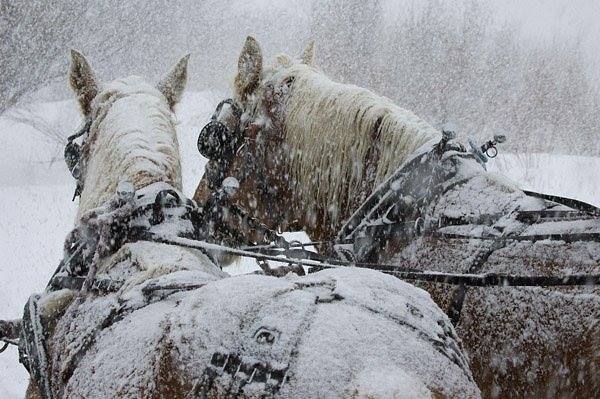
Something jingled in the barn. We stood there, exhaling clouds. Two horses came out the open door. They were harnessed side by side. Their hair was long and thick. Winter coats. They walked over the packed snow, pulling something. A large sled glided from the doors.

A sleigh! I envisioned.

“Whoa!” some deep, well-used voice graveled.

An old man walked out of the barn, then slid the door closed as his horses waited, blowing steam into the crystalline air.

“Come along, boys,” he said, not even looking our way.

I started for the sled, anticipating a ride, but the neighbor kid stopped me. I followed him, walking alongside the rig.

In silence, except for our squeaking boots, we walked toward the leafless forest behind the farmhouse. The horses and sled, guided mostly by the farmer’s voice, occasionally by tugs on the leather harness, led us among the silent trees.

The trees protruded from the white ground, black, stiff, in varying trunk thicknesses. All their branches stood naked, yet did not make me feel death. Nor did I sense that they were awake – they were too stiff.

One tree – and only one – still had a leaf on it. A single leaf. With three thick points, and colors of yellow, rust, and decaying brown. I peered closely at it, but didn’t touch it. When I saw that the steam of my breaths jostled it, I backed away, not wanting to be the cause of its demise.

At the base of another tree, I saw the characteristic pattern of rabbit’s tracks. Two paw prints side by side in front, and two in a line in back. My eyes followed their chaotic path from the tree trunk into the forest.

“Whoa!”

I watched the farmer go up to a dormant tree, and remove a bucket hanging on a hook in the bark. He poured the liquid from the bucket into a tank on the sled.

“Come on!” the neighbor kid prompted us. I found a bucket hanging from another tree. Above the handle, a hollow steel tube protruded from the tree at a downward angle. Clear liquid dripped from it, into the bucket. The bucket was half full of clear liquid.

I took the bucket off its hook and moved it to watch the sap inside. I expected to see a slow, barely perceptible movement. The maple syrup I knew from the breakfast table was frustratingly slow. But it sloshed in the bucket like water.

I stuck my nose down to the opening of the bucket and took a deep breath. There was no odor of any kind, let alone the smell of maple syrup I expected.

“Whatcha’ doin’?” the neighbor kid asked.

“Nothin’.”

I carried it over to the sled. In the flat bed above the runners was a steel tank. It had a thin layer of liquid over its bottom. I added my pail-full, returned the bucket to its hook, and took off in search of another.

We all scampered among the trees, carrying the freezing buckets in our mittened hands, getting warmer from the work. The horses moved slowly within the forest to lead us to other trees not yet harvested.

After 45 minutes, the tank was ¾ full.

“That’s enough,” the farmer declared. He turned his team and we followed the sled in another direction.

We squeaked through the universe of snow at the slow horses’ pace, weaving among the forest of black maples. Then, a whiff of maple syrup awoke me from the trance of black and white.

I saw a shed – nothing more than a roof on stilts, beyond a dozen more trees. Under the shed, thick clouds of steam slowly billowed into the frigid air.

The pungent sweetness increased in our noses the closer we got. I approached this Sorcerer’s laboratory slowly, bursting with curiosity, trembling with fear. The farmer stopped his sleigh alongside the shed. When I reached the edge of the roof, I could hear bubbling. Thick bubbles, like some Pleistocene mud pit.

Beneath the roof, a large sheet metal rectangle, mounted off the ground by about two feet, occupied almost all the space, like some Pagan altar. Split hardwood was stacked on the frozen ground near the steaming, bubbling trough. Beneath it, a fire crackled red and yellow, munching thru a dozen or so logs, atop many days’ worth of ashes.

I approached it, led by my drooling nose. Up on my toes, I peered in. The cloud of sugared steam enwrapped my head and fogged my glasses. I took them off.

Molten gold bubbled there. What had been clear sap in our buckets was slowly concentrating down to this. It mesmerized me: bronze-colored bubbles bursting on the surface; gossamer veils of steam rising, tantalizing; crackling hardwood near my feet; the coating of snow over the world beyond this cook shed.

“Give a hand,” the farmer’s voice graveled.

I broke from my trance and saw him scooping bucketfuls from the tank on the sled.

“Pour careful,” he fixed my eyes. “That there’s hot if’n it splashes.”

We added to the trough’s volume, until everything we’d collected was in there. I watched the amber syrup grow pale and its bubbling decrease.

“How long do you cook it?” I asked the farmer.

“ ‘Til it’s done,” he elucidated. “Then you stop.”

I stood there, attached to the sweet odor in the air like a bull tied by a golden chain to the ring in his nose.

“Here,” the farmer finally thought of something else to do. He scooped out a small ladleful of syrup. “Make a snowball.” Then he drizzled some syrup onto my snow sphere.

I took a crunchy, gooey bite. As it oozed over my tongue, releasing its perfume into my nose, one word came from I-don’t-know-where:

Ambrosia.


October 25, 2015

Persephone, from Where?

Filed under: Uncategorized — cbmosher @ 11:18 pm

(at two and a half months)

You’re waking into our world. As your eyes grow, you watch our smiles, explore the dangling toys we put there for you, perhaps even begin to differentiate colors (I’m assuming there were no colors in the uterus; surprise me and tell me otherwise !).

As your ears grow, you hear a sequence of rising, then falling notes – a song. You hear it so often that it must stand out from the cacophony around you. Notice how it’s frequently accompanied by visions of smiles?

It’s your name.

As your muscles strengthen, you’ve shaped your mouth into a triangle that helps you eat. You explore those noises you can make – your first feeble attempts to express yourself, which will grow, over the years, into the feeble attempts we adults make to express ourselves.

And your hand, that loyal friend from the other world, does it come into view increasingly often? Do you understand that it’s your hand that pushes this toy? That squeezes my finger? And that it is YOU making the hand do that?

Are you beginning to understand how we connect to things here in this world?

Brave little Persephone, you keep smiling as you explore our world. Keep it up; we’ll bequeath this world to you soon enough.

But before you get too deeply in, and ultimately forget where you came from – – –

Tell us – – –

Please – – –

All about Blake’s dell you so recently left.


image1

« Newer PostsOlder Posts »

Blog at WordPress.com.