Sex, Drugs, and Public Health

October 22, 2013

Food: Estonian and Seto

Filed under: Uncategorized — cbmosher @ 5:00 am

Seto Food


The little village of Obinitsa is a cluster of small homes crowding both sides of the road so closely that traffic slows to ten kilometers an hour for that one and a half blocks.

The restaurant, “Seto Seltsimaja” would be easy to miss.  The sign is painted on wood, weather brutalized, and small.  But our Estonian driver had precise directions.

Cats – mother and several offspring, have territorialized the steps to the door.

The owner is a big, smiling man with several missing teeth.  The rest of his family are elbowing around each other in the kitchen.  From the picnic-style wooden table where he seats us, I can see directly into the kitchen.

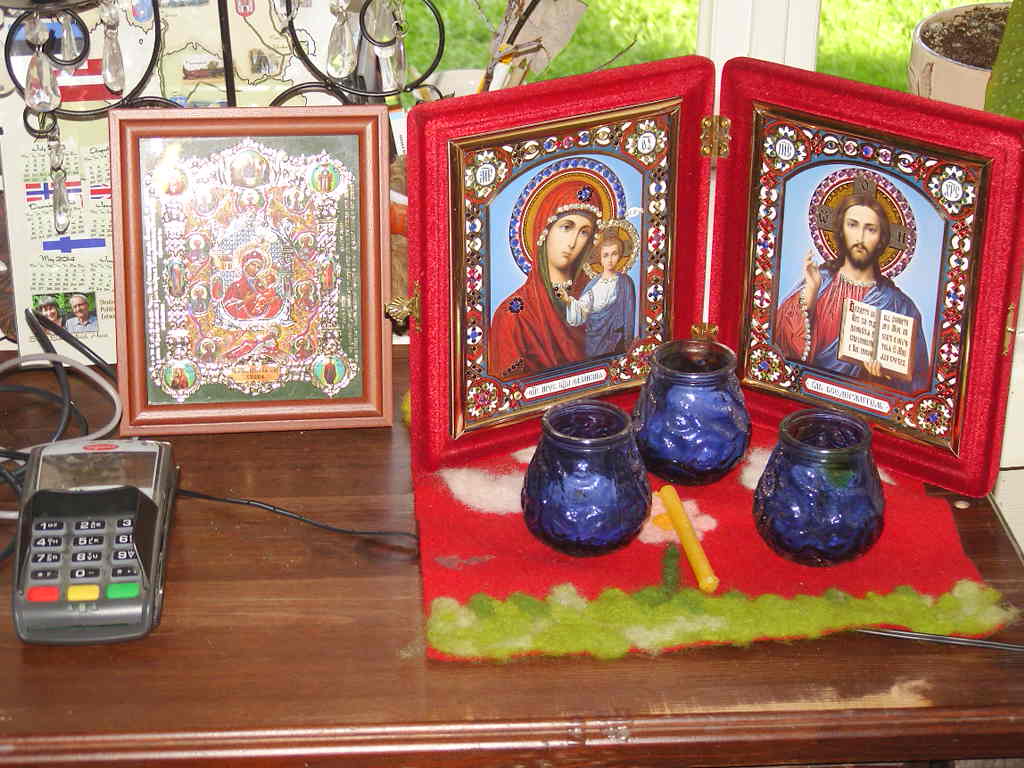
From a small table decorated by lace, religious icons and a credit card swipe machine, he takes a tattered notebook and stands at our table, speaking Seto-flavored Estonian which I assume is a recitation of the menu.


 Image


We English speakers, our stomachs rumbling, decide to let the Estonians order lunch for us.  The food begins to roll in.

He brings a plateful of pickles. drizzled with honey.  The pickles are surprisingly – shockingly – good with their dripping honey.

To drink there is kali, a beer made from rye bread, but containing no alcohol.

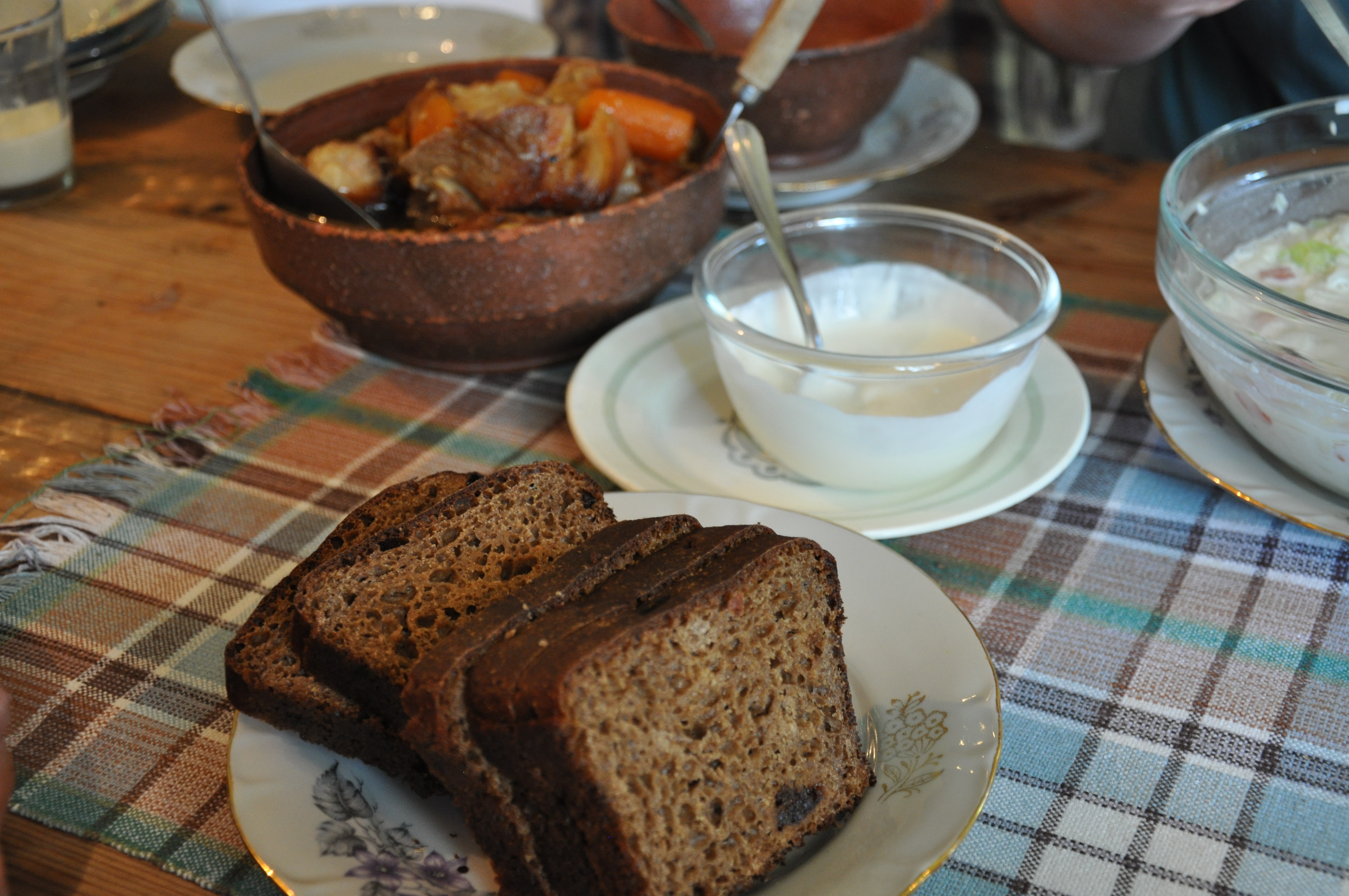
Leib, the dark bread they are famous for, tastes like molasses.

Sai, the white bread, tastes of yeast.

Next is a fish soup with chunks of some species that swims in their lakes, swimming now with carrots.

Then comes another soup: Suuliim, a milk based cold soup with cucumber slices, tomato chunks and pickles.  It reminds me very strongly of the Russian Summer Soup I make with buttermilk and sauerkraut.


Image 

A big steaming pot with a beef shank swimming in hot juice, the meat slipping from the bone by sheer gravity.

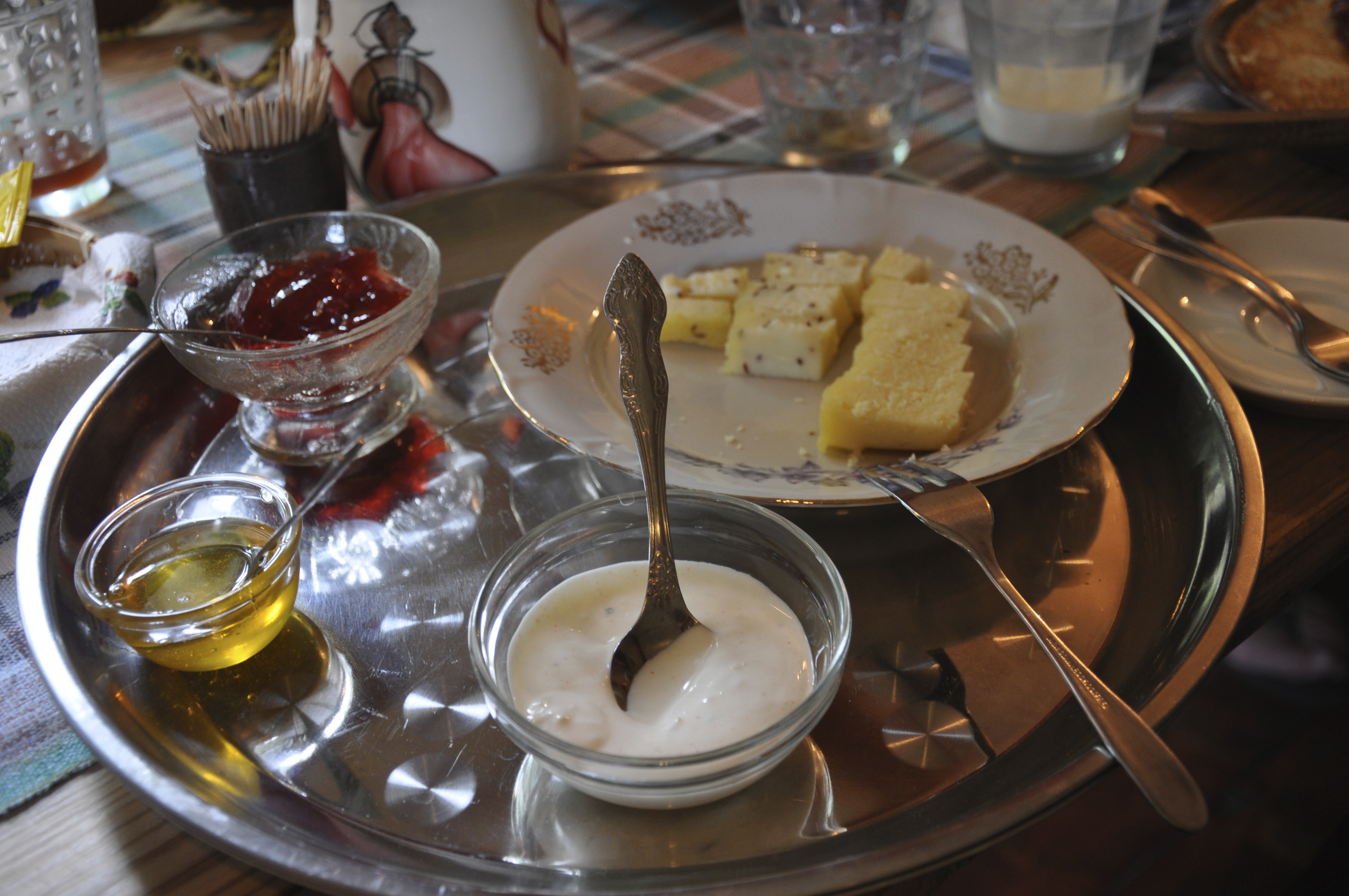
We are stuffed, but he brings sõir, chunks of some unique cheese with three dipping sauces: sour cream with garlic, honey and berry jam.

As an additional dessert, I also order a pankoogid (pancake) with lingonberry jam.

We eat in the downstairs of his wooden home. Near our table is a large, rectangular cement structure which has a fire box built into it on one side. It is molded, on the other side, into a long bench.  In winter, he explains, the bench is warm due to the fire which heats the cement stove. Today, cats occupy the bench.

The kitchen has some surprising amenities including a hood over the stove.  But I watch the gray haired woman who directs a young boy as her assistant, prepare my pankoogid by stirring the batter in an old tin can.

It is a Medieval meal in an (almost) 20th century kitchen.


 Image


                                                Estonian  Food


Breakfast

         Pancakes with lingonberry jam

         Assorted cheeses

         Smoked fish

         Potatoes

         Sausages

         Scrambled eggs (a.k.a. “porridge”)

         Oatmeal

         Salami, sliced

         Cold meat cuts

         Tomatoes

         Cottage cheese

         Fruit

         Yoghurt

         Breads


Lunch


         Bread

         Cheese

         Fish

         Soup


Dinner


         Fish

         Chicken

         Beef

         Soup

         Black currants


October 13, 2013

Estonia: In the King’s Court

Filed under: Uncategorized — cbmosher @ 4:43 am

 This post to Sex, Drugs and Public Health documents a recent trip to Estonia


In 1290, the Teutonic Knights grabbed a trading port on the Baltic which would someday become the capital of Estonia.  They pushed inland to force their influence (i.e. religion) upon the people of that land who lived in harmony with the forests.

At the same time, Czarist Russia pushed across its border with eastern Livonia – the early name for Estonia – and exerted its influence (i.e. religion) upon the people who lived in harmony with the forests.

Today, we drive deeper yet into rural Estonia.  Gone is digitally driven, high rise Tallinn.  Behind us the resort town of Pärnu and the university city of Tartu.  We go even beyond the small town of Tiina’s birth, picturesque Võvu, situated on a couple of small lakes, surrounded by farms.

We head straight toward the Russian border.  Dense forests, wildflower covered fields, occasional farmhouses.

We have an appointment with a King.

“It says here,” someone reads from a reference book, “that the Seto speak a different variation of Estonian, dress differently, and arrange their homes in clusters, not widely separated as all other Estonians do.  They’ve lived in Setomaa – the land of Setos – for millennia.  Part of Setomaa is in Russia, the rest in Estonia.  This causes problems for them.”

A very familiar problem:  Kurds, Iroquois, the Aché, the Basques.

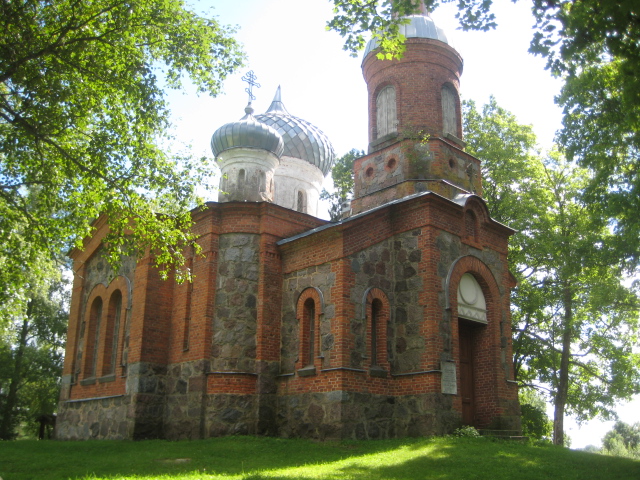
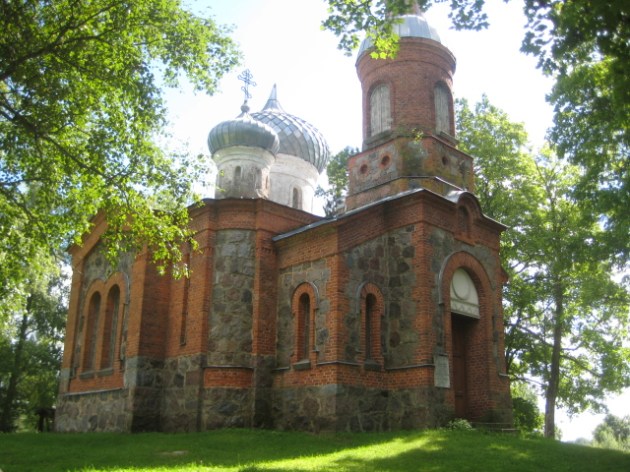
The road leads us past a church, very old, deteriorating, but still spectacular.  Onion-dome cupolas with Orthodox crosses atop, walls and doors of wood as weathered as the bark of near-by trees that umbrella over the church roof.  Two barefoot children sit quietly on a bench in front of the church waiting for something.

We stop.  Our cameras click.  The children ignore us.
Image

We come to the village of Muraski, a mere five kilometers or so from the Russian border, and drive beyond, into yet more of the patchwork landscape of wildflower fields and dense forests. We turn onto a gravel road and eventually pull into a driveway.  The house is of wood planks. “Simple” would be an understatement.

I was prepared to meet an uneducated grizzled old guy draped in traditional patterned wool receiving us with stoic seriousness from his throne, perhaps wearing leather boots elaborately bedecked with antique Russian coins.

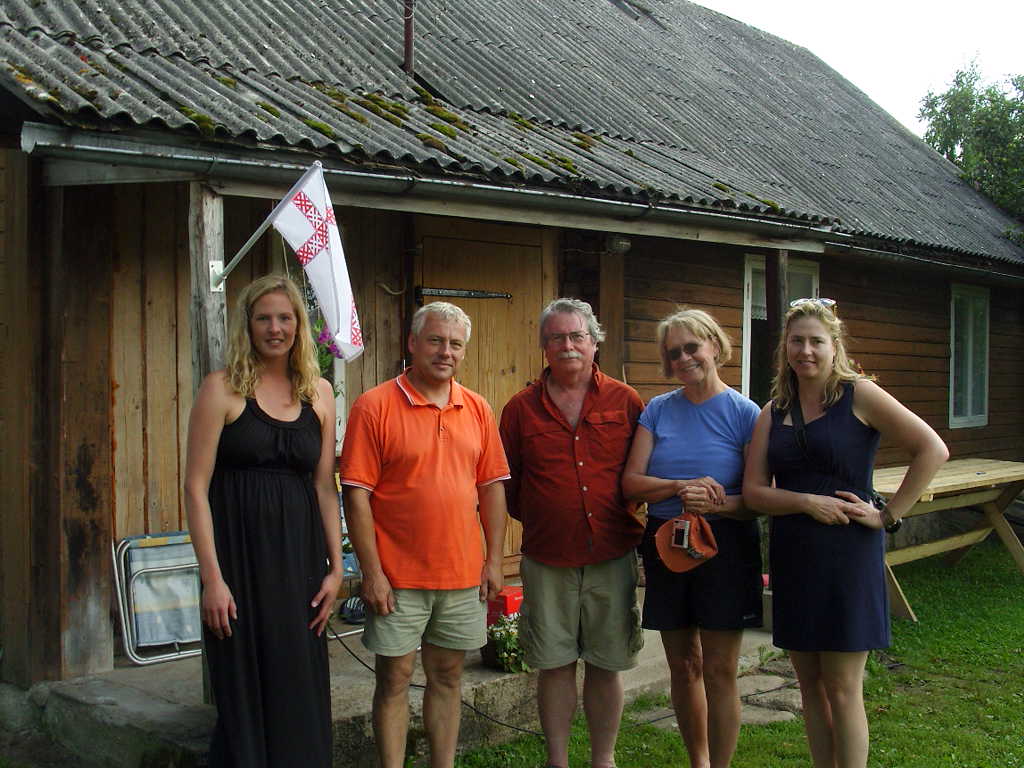
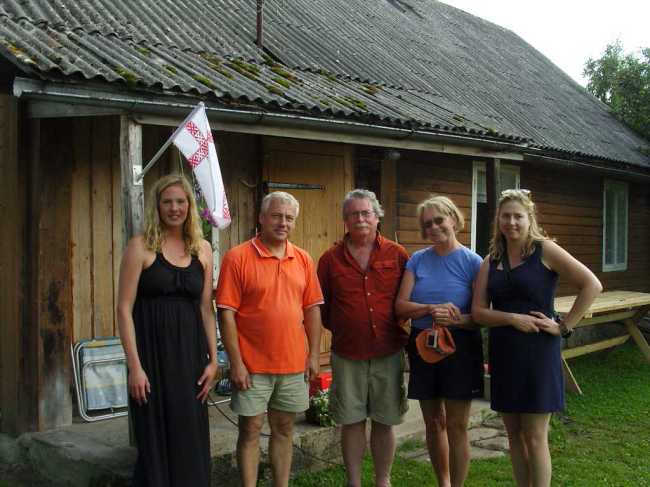
A man comes to greet us, wearing a polo shirt, shorts and flip flops.

“This is the Űlemsootska,” we are introduced by our family guide, Iivi.  “The King of the Seto.”

What do I do?  Bow?  Kiss his ring?  (oops, no rings.)  Address him by his title? Just rely on Iivi’s translations?

“How do you do?” he asks in English, shaking my hand.  “Thank you for visit to my home.”

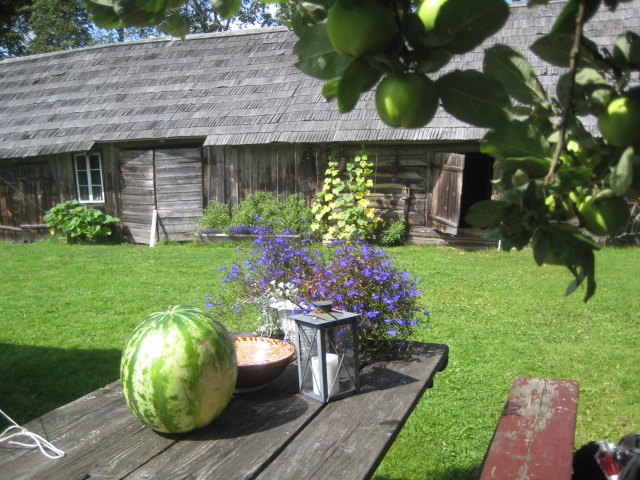
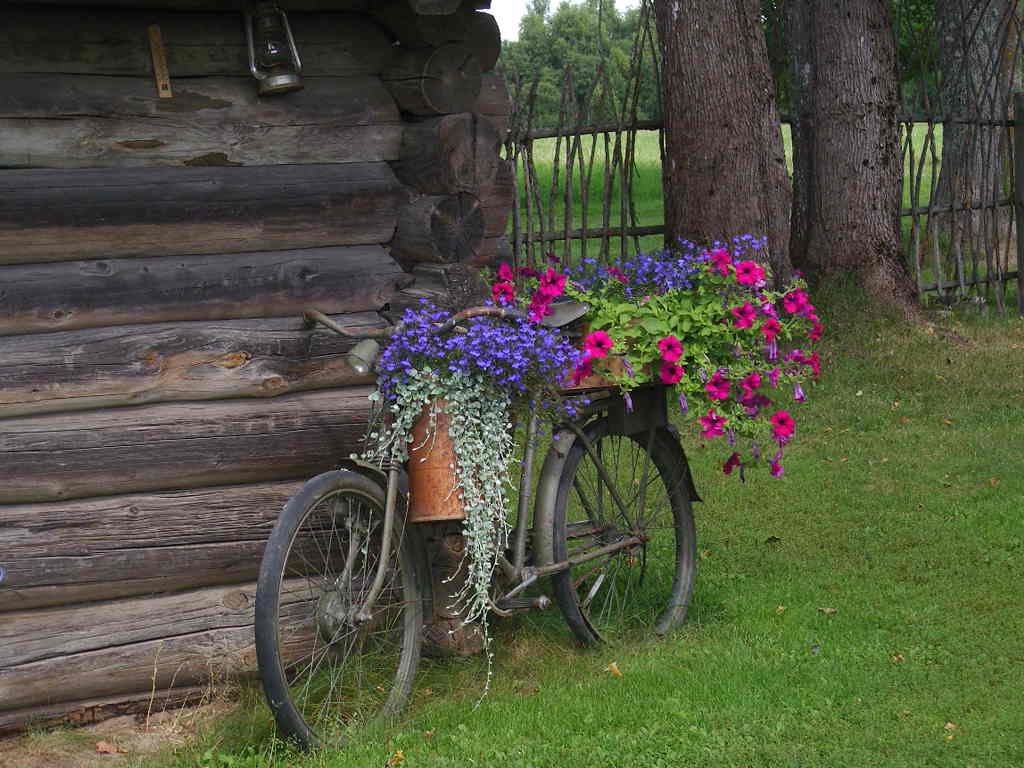
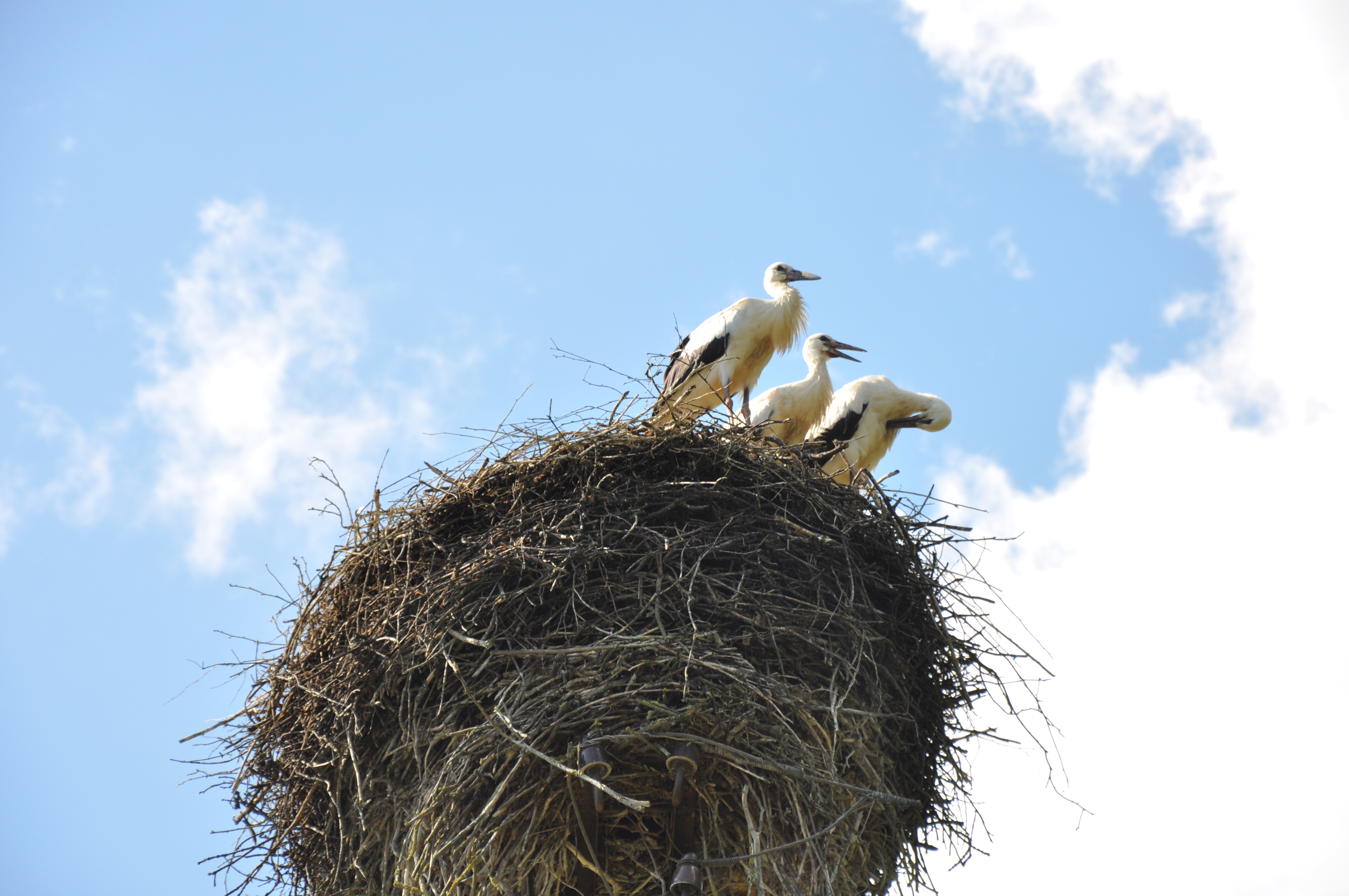
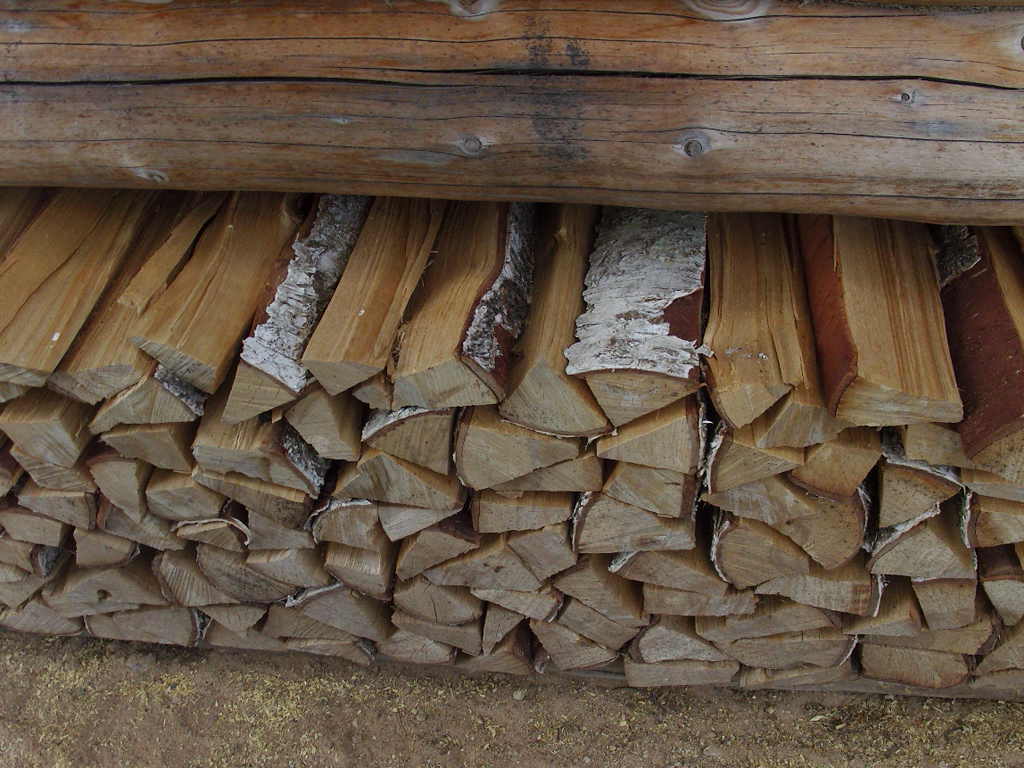
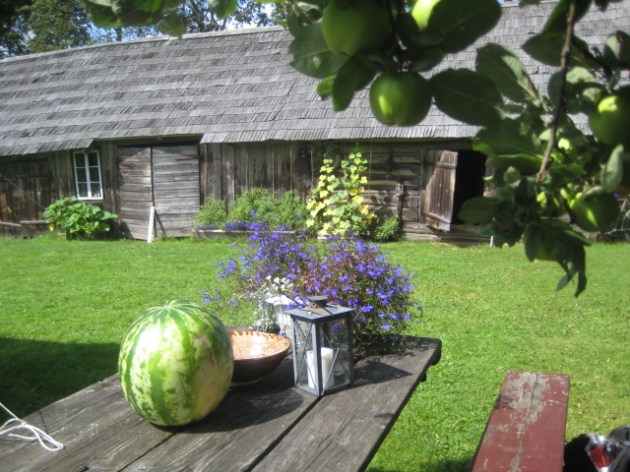
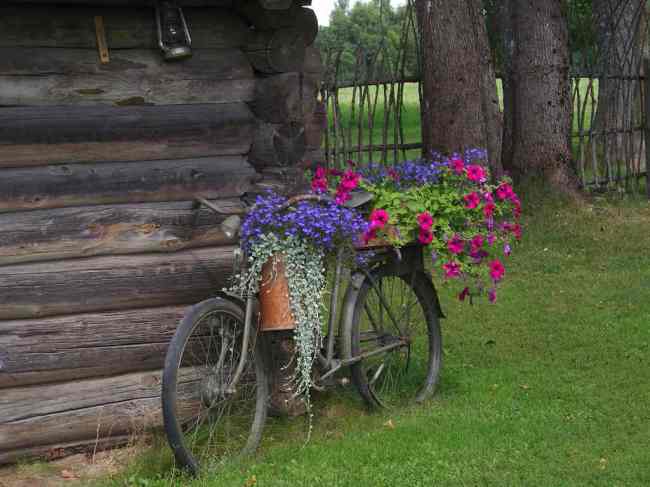
He leads us into his backyard.  Deep green grass is bordered by his house, a very old log constructed shed whose slowly collapsing roof line undulates like ocean waves, a shed stuffed with carefully stacked birch firewood, the outhouse, a garden plot of large multicolored flowers, a pond, and – of course – the sauna. A bicycle, re-purposed as a flower pot, draws my attention, and a smile. An apple tree sheds fruit with audible “thumps” all during our one hour stay.
Image

He leads us to a mosquito netted gazebo like the kind that you buy at WalMart, and polishes a half dozen wine glasses.  He pours cava.  We all wait.  He says nothing.

“To the King!” I offer.

“The King!” our party echoes.

He smiles.

“I am not King,” he begins, still standing, regally erect.  His face is handsomely muscular.  His white hair is short.  His arm muscles and leg muscles are those of a 30 year old.  In spite of his informal dress, he exudes class.  With a soft yet clear voice, he slowly parts the embroidered curtain of his people.

“I am Regent of zee King,” he trills the “R.”  “Zee king of Seto is, in zee monastery, sleeping.  Űlemsootska means zee one who brings message.  King in monastery sends message to me – I speak for King to my people.”

Just like the Aché head man’s job description, I think, minus the Russian monastery.

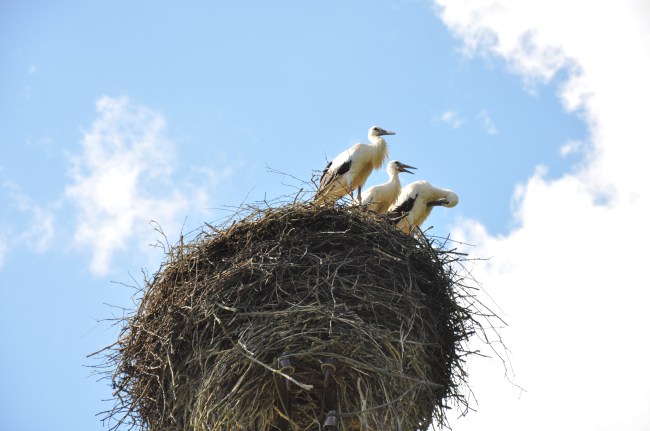
“Long ago,” his ‘g’ sounds accentuate, “zee Germans take Estonia.  Zhey make us change to zheir ways, to Lut-eran church.  Here…” he smiles easily and sweeps the green fields, nesting storks, abundant lakes and fertile forests surrounding his home, “Seto people are practicing Orto-dox church.  From Russia.  Ve don’t vant to change.  So ve live separate since zhat time, here in Souse Estonia.  Zis is how it is.

“Is my chob, Regent for Seto King, to tell vorld about us and, in Tallinn, to be certain parliament tink about Seto in zheir laws.”

“How do you become King – I mean, Regent?” I ask.

He smiles broadly and tips his glass toward us, sips, then continues.

“In zee old days, was honor to be King – but also dangerous.  You are King for one year.  Zhen,” he grins toward me, “Vhat happens?”

A pause.  A shrug.

He slowly draws his finger metaphorically across his throat.

“Zey cut off, from zee King, his head.  But ve Seto are only twelve zhousand of us.  So ve are too few.  Ve change and now zee King keeps his head.”

“It’s good to be King,” I quip before I can send a message to my mouth to not open.  “Please, sit.  Is this your throne?” I point to a canvas recliner he’s set up among the plastic yard chairs.

He laughs.  “No.  Not trone.  You may sit.  I have trone, but not here.”

Some of our party sits to sip the wine.  But I decide to remain standing as long as he is.

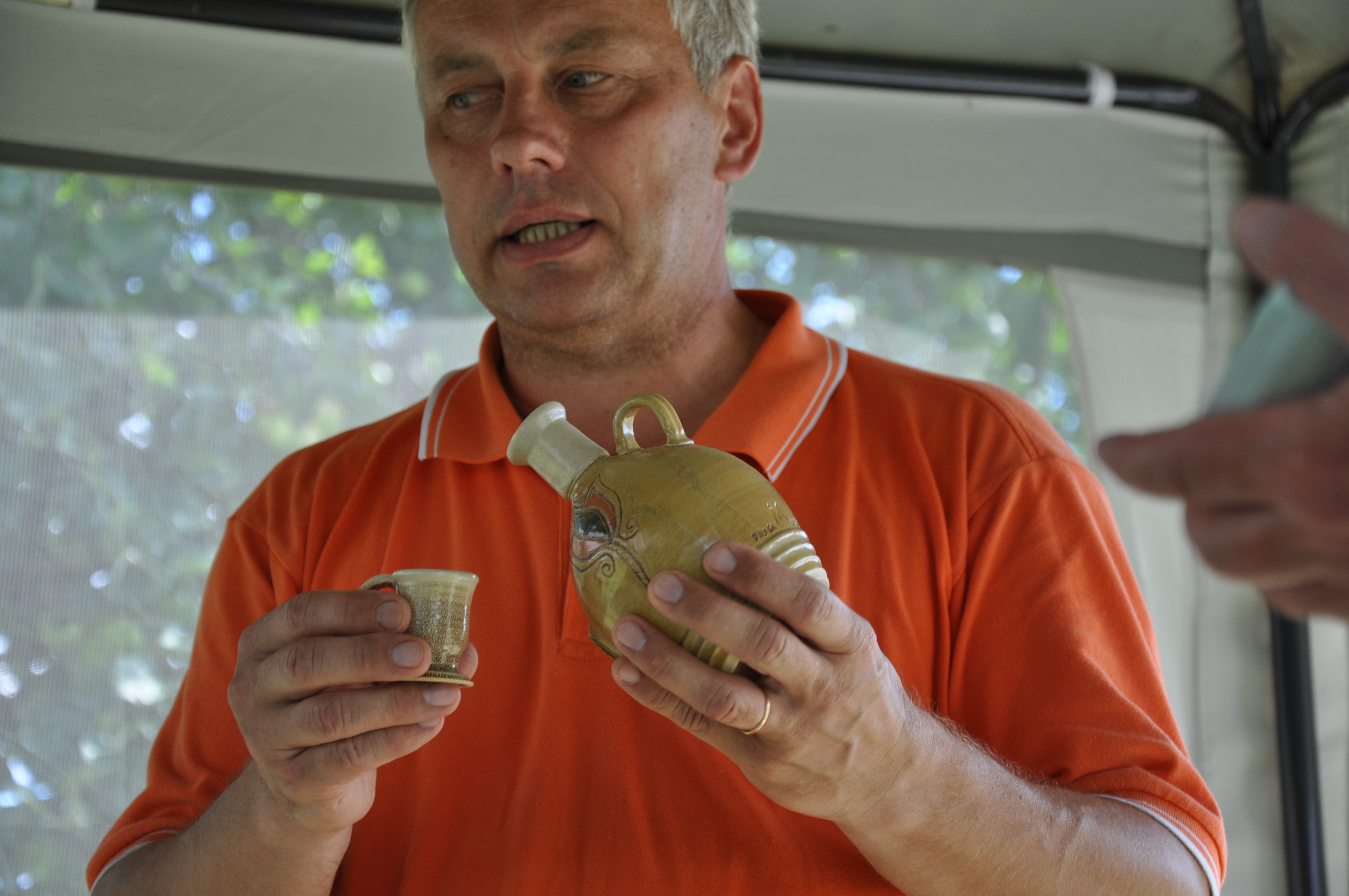
He sets down his wine glass softly, picks up a small ceramic flask and his eyes sweep us.

“You have, none of you, visa to visit  Setomaa.”

End a word with “maa” which means “land” and you are describing a specific place.  Separate and distinct from the other “maas” in Estonia.

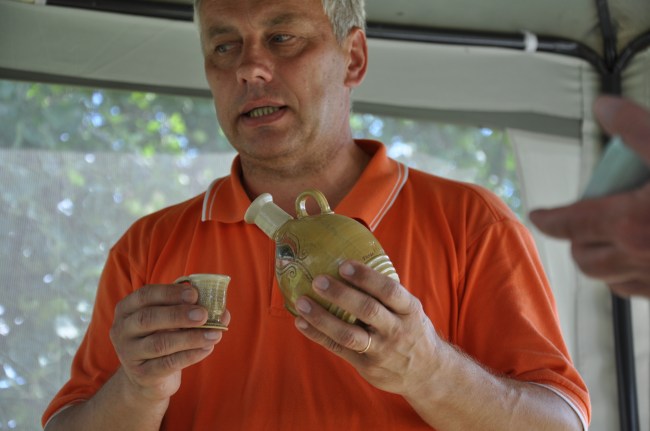
“So I fix for you.  Zhis is hancha – is vodka ve make at home.  Very good.  Very good.  I offer, you trink, zhen you have visa.”
Image

With pride he pours a bit into a very small cup, preparing to give it to someone.

“You must trink, each one, around zee room in ziss direction” – he indicates a clock-wise progression – chust as zee sun, through the sky, moves.”

That puts me first up.  I picture home distilling in Appalachia.  I recall moonshine blindness from contaminated booze.  I call upon faith to be my guide in this.  Faith in people.  Not all people, but, I decide, faith in this man.  It feels like a good decision.

It tastes like clear, clean, fire.  I take it in little sips to avoid choking in front of the King. I finish it, and he pours the next cupful.

The hancha makes its ceremonial round, and only one of our party decides to chug the entire shot.  She pays the price in doubled-over gagging and wheezing.

“Now,” he holds the empty shot cup in one hand and flask of hancha in the other,” King may not take unless one of you – wiz your new visas – you offer it to zee King.  You say ‘No.  You trink first’.”

Oh.  Oh.  I think.  We were supposed to do that initially, from respect, maybe?

He slowly pours hancha into the little ceramic shot cup, fixes my eyes with his, and extends it to me.

“For you,” he says.

I take it.

“Please,” I say, handing it back, “you drink first.”

He smiles broadly.  He drinks.  Finally, he sits.

“Questions for me, you half?”
Image

“Do they pay you to be King?”

He laughs.  “Is expensive to be King.  I must, all zee time be travelling.  To Tallinn.  To graduation of Seto children in Tartu.  Soon – zhis afternoon – I must go Helsinki.  Zhree hundred Euros a year zhey pay me.  Zhat is gone wiz two trips to Tallinn.”

“How do the Seto people choose a King?”

“Ah!” he animates even more on this topic.  He stands up.  “Choosing Seto King is most democratic process in vorld.  Vonce a year, early August, ve have big festival.  If you vant be King, you stand up on top of box.  Other person who vants be King, also stands.  Zhen all the Seto people line up in front of you.  Person viz longest line is King.

Transparent voting I think.  That’ll test friendships.

“Of course, sometimes,” he continues, “zhere are problems.  Sometimes person stands one line while ve count, zhen jumps into other line, for other – how you say? – candidate.”

“We have that in America,” I blurt, thinking of Chicago.

“Why do you want to be King?” someone asks.  “It sounds difficult.”

He sits, and smiles pensively.

“When I am young, I leave Setomaa.  I verk in marine.  Sail the vorld.  But now I am fifty.  Vhen you reach fifty, you need more zhan money.  Zhis place is my grandfather’s place.  I come back.  It feels like home.”

Two more ripe apples drop with a thud.  I look again at the flowers, the green fields, the bike.  Rural peace envelopes us.
Image

“Zee vorld is rounded,” he expands his thoughts.  “If you start from here –” he points his finger to the earth beneath our feet – “you must come back here.”

“If you must get out the word to your people, but there are 12,000 of them all over the world, how do you do that?”

A fly buzzes my ear.  I swat angrily at it.  Flies have been everywhere in rural Estonia and very obnoxious.  I need a fly swatter but no tool so advanced is in sight.

“Ah,” the King slides easily into his answer.  “I use Facebook, of course.”

He stands and reiterates his need to begin his journey to Helsinki.

“You must go to Obinitsa on your way home.  It is capital of Setomaa.  Zhere is restaurant – very good restaurant.  Zhere you get good Seto food.”

And he ducks his handsome white haired head out of the gazebo to go down to his sauna by the pond.  The raw wood shack by the pond.  To clean up for his royal trip.
Image

October 9, 2013

Estonia: The Bog

Filed under: Uncategorized — cbmosher @ 7:30 am

 This post to Sex, Drugs and Public Health recounts a recent rip to Estonia.

Ten P.M. last nite and the sun was still up. Four –thirty A.M. today and the sun’s already up. August and I need a sweater.

Not in Mariposa anymore. Probably not Kansas, either.

Alex expressed a desire to do “bog walking” on this trip. So that’s on today’s agenda.

Mr. Google told me, all the way back in Mariposa, that it involves donning snowshoes to traverse what, I deduced by reading between the lines of the carefully worded tourist info, was probably quicksand.

This’ll be interesting.

Our hostess has retained a guide. Tall, lean, with the bulging veins of a vegetarian exercise freak who has no body fat, he speaks to us in the charmingly constructed English most educated Estonians exhibit.

Image

His points:

  •  Bog, zhis one, is National Park,  seventeen kilometers wide;
  • Bog is not swamp;
  •  On the developed trail, you must stay;
  • Vhere you stand is under water. Is flood in Autumn. Up to here (he indicates the top of the sign, above his head). Is flooded, also, zee forest. Then the Bog, she grows;
  • You have suit? You can swim in Bog.

I remember an old National Geographic article about a northern European “Bog Man,” excavated about 4000 years after his death.  I vividly recall the photo. Not just a skeleton – a very well preserved guy with his shoes and clothes of hide still attached, but everything – including his skin – turned to leather.

Tests revealed him to be in his twenties.

         How did he die in the bog? I wondered then.


         Was it slow suffocation in quicksand? I wonder now.

A wooden walkway, raised above the forest floor on 6 by 6 beams, leads us quickly thru the birches, larches, pines, blackcurrant bushes, mushrooms and frogs of the forest. A forest which, as you drive thru Estonia, still covers half of the country.  They cleared areas for fields to grow their food, but the edge of the fields is defined by a dense wall of trees which is just itching to reclaim its ancestral soil.

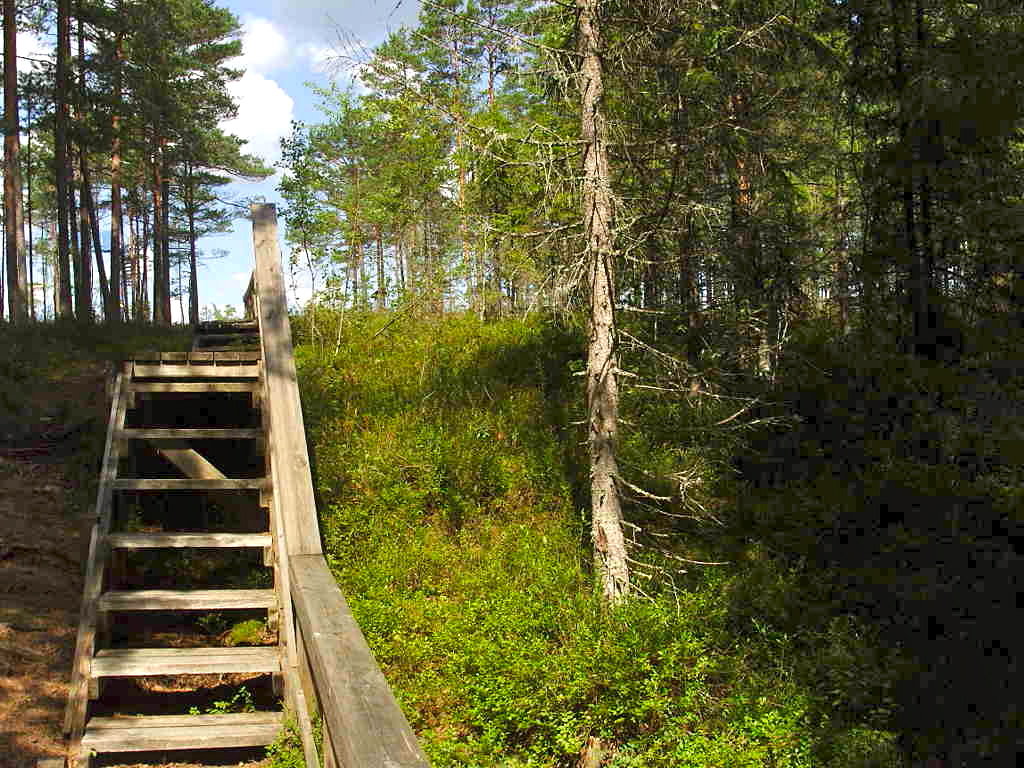
Back from the digression, we approach the bog after a kilometer of walking. The walkway turns into steps. The steps go up.

Up?

“Is growing, the bog,” our guide explains, trilling his R’s. “Every year, a little bit more. The forest does not, zee same way, grow. But zee bog vill – how you say? – Eat. No. Take over. It vill, zee forest, take over, little by little.”

Image

I put my foot down – speaking literally here – to test the forest floor. It’s damp and green. Your eyes tell you that much. But it’s firm. Like any Pacific northwest forest floor.

Up the steps, onto a plateau about six to eight feet above the forest floor. Suddenly, sunshine and almost no trees. A few scraggly pines and even occasional twiggy birches grow as pathetic invalids. Otherwise, just a wide, flat carpet of green to the horizon where forest begins again.

We continue on the wooden walkway, now on the Bog, elevated above the forest. I put my foot down again.

Like stepping on a saturated sponge. I hear “squish” and water oozes up to flood over my sneakers. I feel no sense of firmness and wonder how deep I’d sink if I just stepped off with the other foot, too.

Not really needing to find out.

I snag the guide and ask him how this swamp can be higher than the forest floor.

“Not a swamp,” he reminds me, this bog aficionado. “Swamp is in warm climb-ate. Zhis is Bog.”

He reaches down to the thick green that is the surface and snatches up a handful of dripping green sponge.

“Sphagnum,” he explains. “It grows. Gets ticker. Higher. Every year, a little bit.”

Sure enuf. Looks like the stuff I recently bought at Mariposa Feed store to incorporate into our garden. To hold the moisture. Makes sense. But this sphagnum, unlike mine, looks happy, healthy. It’s dense green, sopping wet, and holds itself together with curling tendrils.

Like living Velcro.

As we walk deeper into the bog, it’s clear that the carpet of sphagnum plays host to multiple other plants with tiny flowers and, as mentioned above, to the unfortunate seeds of trees that landed a bit too far from the forest floor.

Another half kilometer, and our narrow walkway leads to a platform – I’m thinking “raft” – at the edge of a large pool of black ink. A hole in the sphagnum formed by – – – .  Well, I didn’t ask.

“Swim!” the guide beams like a gracious host.

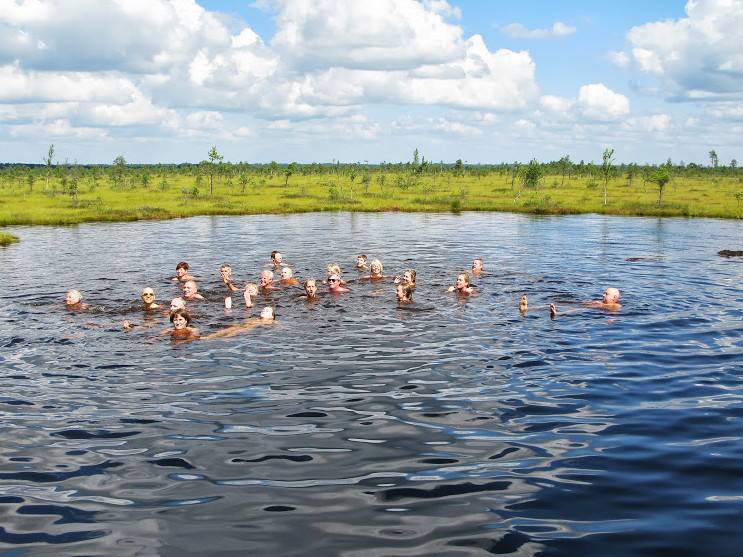
“Splash” goes Estonian number one. “Splash” the cousin from Sweden. “Splash” the Canadian relative. Why not? “Splash” the Californian.

Image

It’s not surprising there’s nothing substantial beneath my feet. Visions of Bog Man refuse to be evicted from my brain. He’s down below me. He could be me. As I often do, I tell my brain to shut up.

I swim to the opposite bank to see if there’s substance there. Nope. The sphagnum surface just collapses into the pool. You can grab onto some sphagnum if you want to stop treading water for a few seconds, but all you get for it is a handful of dripping moss detached in your hand, and a sinking feeling.

So it’s float, and let the sun shine onto your face.

“A record, it is!” the guide yells. “Never before, zhis many people in zee pool. I take picture.”

Which he does with what he calls his “camera”

“Click” goes his i-pad.

I twirl. Must be 20 of us in the water. Some organized person calls for us to make a circle. Like ducks, we smile and appear comfortable while our legs thrash like crazy somewhere in the dark beneath.

Then someone submerges her blonde head, inverts upside down, extends her leg with gracefully pointed toes, and challenges us to Bog Water Ballet.

Eventually we climb up onto the platform again and devour the contents of the picnic baskets.

“Hot day,” observes an Estonian as I wrap a towel around my shivering self. I’m looking forward to sauna # 2.

We descend the steps from the bog. Katie emerges from the woods, her hands bloody from blueberry picking. Not blood, really. Berry juice. But it gets a few horrified gasps.

I feel a peace about being enveloped again by dense forest. The familiar forest.

Image

“Dust thou art, to dust returneth” was not spoken of the Bog.

October 5, 2013

Estonia: Farms

Filed under: Uncategorized — cbmosher @ 5:28 am

This post on Drugs Sex and Public Health documents observations on a recent trip to Estonia.


Far from the rapidly modernizing capital, a half hour ferry ride across Baltic waters, the island of Saaremaa takes you back 100 years to the fishing and farming past of Estonia.

And, it appears, propels you into the country’s future.

We stand on the north shore of Saaremaa island, facing the Baltic.  A grey sea of water beneath a grey sea of clouds.

Flowers grow right to the water line, whipped by the wind that swirls out of Sweden, across the water, to Vikingize our hair.

Lightning silently flashes the grey clouds translucent. We hear only the washing of waves and humming of pine needles in the forest behind us. A full minute later, thunder rumbles, low and distant, from the horizon where sea and clouds fuse.

The wind suddenly intensifies and almost lifts a boat on the beach. The first thick drops splash our faces.  We turn our backs on the lightning show and head back to the cabin.

From our beds, we listen to the wind blast like the proverbial wolf at our roof of straw. We wince as the sudden explosions of electricity blind our dreams and simultaneous cracks of thunder vibrate the cabin.  We smell, all night, the fresh perfume of pelting rain.

Morning puddles disappear within an hour under the returning sun.  Thick clouds, residuals of the night storm, shadow across the sun briefly and non-threateningly. The day will be available for exploration.

Twenty kilometers down the road, surrounded by broad flat fields of hay, stand three old windmills.  Immobile now, their big blades decaying in the Baltic weather, the mills have been demoted to a tourist attraction.

 Image


Here amid the Estonian farms, horses were given a reprieve in the 1920’s from the work of pulverizing grain into flour when craftsmen built the mills. They are two and three stories high, with wooden gears and twenty foot blades.  There are giant handles on the windmills so they can be turned into the wind.

Everywhere is grass and hay, thick with chlorophyll and fragrant under our steps, irrigated by the Baltic’s weather.  The dependable alternation of rain and sun keeps their rich, black soil producing, century after century.  The morning’s wind snaps at flags and at our clothes.

 Image

Further on, we approach the port (“sadam” in Estonian) to catch a ferry back to the mainland.  Looming above the ubiquitous forest, like some Star Wars invasion machines, wind generators turn slow, powerful revolutions.  Once every six seconds on this day, as they face the Baltic and harvest its energy.

Estonia still gets 90% of its energy in Soviet fashion – from mining and burning oil shale.  This little country has the world’s largest oil shale processing plant and led the world in oil shale production in 2005. Most of the rest is imported natural gas and Nordic hydropower.

But, just as they extricated themselves from Soviet overlording in their social and political lives, they are moving in their own direction with energy production.

Currently wind power supplies 4% of Estonia’s grid capacity (almost the European average) but their goal is 14% by 2020.


Image 

The 2020 target for all renewable energy sources is higher: 20%.  Currently, other than wind, its biomass.  But solar is on the planning boards. If Germany can do solar (it is the leading solar producer in Europe), Estonia’s Baltic weather should allow it, too.

Estonians have always known how to build a farm.  They have what they need for it in their land and their weather.  They are now beginning a new phase: farmers of wind, farmers of solar, farmers who repurpose their biomass.

Estonians have also shown their ability to adapt to other skills and to build for the future (invention of Skype as most obvious example).  They already have built a network of 165 “fast charging” stations for electric cars.

Some of their young visionary engineers are proposing 100% of energy production from renewables by 2030.

Don’t bet against them.


 Image


October 1, 2013

Estonia: The Church

Filed under: Uncategorized — cbmosher @ 4:39 am

This entry on Sex, Drugs and Public Health documents impressions of Estonia from a recent trip.


We did Tallinn for its ancient walled town, surrounded by glass high-rises and electronic gadget businesses.  Women in heels; men in suits.  Metaphoric electricity in the atmosphere, as the country erupts in creativity and capitalism from beneath the fifty years of Soviet domination. Like some spectacular mushroom overnighting on ground previously covered by a cement block. Mercedes, Volvos, and Subarus have replaced horse-drawn wagons.

But the wagons aren’t far away. Now we’re ten kilometers or so from Pärnu, a Baltic sea resort-like town, in a bird-tweeting, horse munching agricultural area where dense forests of birches straddle cleared fields that, judging by the buildings, have grown food for several hundred years. Many fewer English speakers here, and there are no clues within the Estonian language to help you decipher it. Nothing in common with Latin; nothing with German; nothing with Slavic languages, even Russian.

IMG_8062

The commonality is, you might expect, the smiles, the pantomiming to communicate, the straightforward kindness which, for me, recalls my childhood among Polish immigrants in upstate New York.

Trippy (accidental) synopsis of the history of this country tonite.  The accumulated descendants of the Ilja family finish a day of canoeing the river, of lobstering in the sauna, of beer, local fruit wine, dinner, and vodka, by lighting candles and walking to an abandoned near-by church to remember “the dead” (AKA ancestors). Within the dark that finally arrives after 11:30, we approach the “church” and a local explains its history. One of the family members – descendant of farmers, a young woman, and now a lawyer, translates.

The rectangle of thick stone walls and often patched cement was commissioned in the mid 1800’s. The Czar himself paid for it. People came, back then, only because there was a school built nearby to educate the farmers’ children, a gift valuable enuf to them that they began attending the Occupier’s church, too.

Then, in the era of collective farms, it was converted to a different use: storing hay for the horses.

In the 1950’s (Soviet Era) it became a mill for grains and a storage for barrels.

As the Soviet dominance weakened (late 1980’s), the local people began using it to celebrate “The Birth of the Sun” every winter solstice. (Amazing how tenacious Belief Systems are, even crossing generations).

We pull open the crude wooden doors, stumbling in the dark over the earthen floor. Candlelight provides some flickering illumination. Barrels line the sides where pews would be in a western (non-Orthodox) church. “You can sit on the barrels” the translator offers. Everyone chooses to stand.

DSC_0364

A simple stone altar is perched a couple of feet above ground level. Two steps. We place our candles on the first step, in a semi-circle. An eerie symmetry of beauty. The descendants of the Iljas, survivors of the vicissitudes of famine and bad weather, of banishment to Siberia by the Soviet overlords, of feverish scattering from the war, bombs falling on them as they ran, stand silently in the dark church/forage house/mill, watching the candles flicker and erase a hundred years of time. There are Ghosts among the survivors.

DSC_0363

Then someone speaks a few soft words of Estonian, and begins a traditional song. Several join in.

The leader of the song read the lyrics.

On his i-phone.

So, from Russian serfdom, thru turbulent occupation, banishment, and starvation, to the invention of Skype and leadership in the digital revolution: I see the recent history of Estonia and of this family reflected in the interior of that “church.”

Other events are planned for today, but I have no idea what they are. There is no hope that I will learn this unusual language, which seems to have grown from the earth like rhubarb over the centuries. I’m at the mercy of their pantomime and their kindness.

I’m in good hands.

SAMSUNG DIGITAL CAMERA

« Newer PostsOlder Posts »

Blog at WordPress.com.