Sex, Drugs, and Public Health

October 9, 2013

Estonia: The Bog

Filed under: Uncategorized — cbmosher @ 7:30 am

 This post to Sex, Drugs and Public Health recounts a recent rip to Estonia.

Ten P.M. last nite and the sun was still up. Four –thirty A.M. today and the sun’s already up. August and I need a sweater.

Not in Mariposa anymore. Probably not Kansas, either.

Alex expressed a desire to do “bog walking” on this trip. So that’s on today’s agenda.

Mr. Google told me, all the way back in Mariposa, that it involves donning snowshoes to traverse what, I deduced by reading between the lines of the carefully worded tourist info, was probably quicksand.

This’ll be interesting.

Our hostess has retained a guide. Tall, lean, with the bulging veins of a vegetarian exercise freak who has no body fat, he speaks to us in the charmingly constructed English most educated Estonians exhibit.

Image

His points:

  •  Bog, zhis one, is National Park,  seventeen kilometers wide;
  • Bog is not swamp;
  •  On the developed trail, you must stay;
  • Vhere you stand is under water. Is flood in Autumn. Up to here (he indicates the top of the sign, above his head). Is flooded, also, zee forest. Then the Bog, she grows;
  • You have suit? You can swim in Bog.

I remember an old National Geographic article about a northern European “Bog Man,” excavated about 4000 years after his death.  I vividly recall the photo. Not just a skeleton – a very well preserved guy with his shoes and clothes of hide still attached, but everything – including his skin – turned to leather.

Tests revealed him to be in his twenties.

         How did he die in the bog? I wondered then.


         Was it slow suffocation in quicksand? I wonder now.

A wooden walkway, raised above the forest floor on 6 by 6 beams, leads us quickly thru the birches, larches, pines, blackcurrant bushes, mushrooms and frogs of the forest. A forest which, as you drive thru Estonia, still covers half of the country.  They cleared areas for fields to grow their food, but the edge of the fields is defined by a dense wall of trees which is just itching to reclaim its ancestral soil.

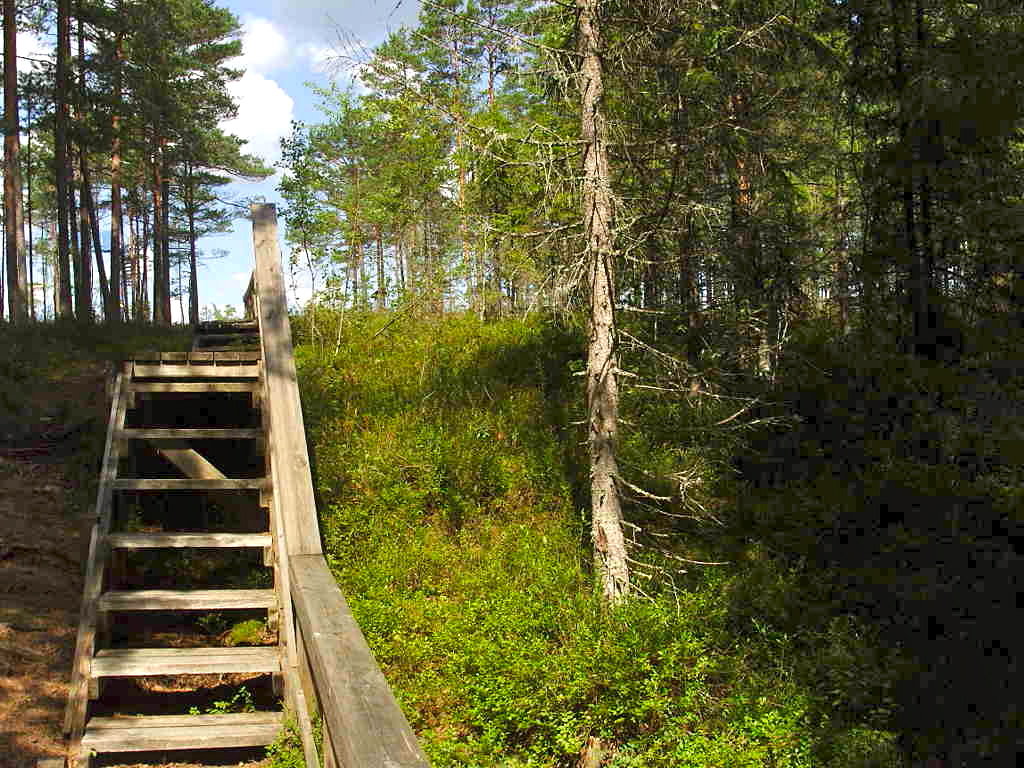
Back from the digression, we approach the bog after a kilometer of walking. The walkway turns into steps. The steps go up.

Up?

“Is growing, the bog,” our guide explains, trilling his R’s. “Every year, a little bit more. The forest does not, zee same way, grow. But zee bog vill – how you say? – Eat. No. Take over. It vill, zee forest, take over, little by little.”
Image

I put my foot down – speaking literally here – to test the forest floor. It’s damp and green. Your eyes tell you that much. But it’s firm. Like any Pacific northwest forest floor.

Up the steps, onto a plateau about six to eight feet above the forest floor. Suddenly, sunshine and almost no trees. A few scraggly pines and even occasional twiggy birches grow as pathetic invalids. Otherwise, just a wide, flat carpet of green to the horizon where forest begins again.

We continue on the wooden walkway, now on the Bog, elevated above the forest. I put my foot down again.

Like stepping on a saturated sponge. I hear “squish” and water oozes up to flood over my sneakers. I feel no sense of firmness and wonder how deep I’d sink if I just stepped off with the other foot, too.

Not really needing to find out.

I snag the guide and ask him how this swamp can be higher than the forest floor.

“Not a swamp,” he reminds me, this bog aficionado. “Swamp is in warm climb-ate. Zhis is Bog.”

He reaches down to the thick green that is the surface and snatches up a handful of dripping green sponge.

“Sphagnum,” he explains. “It grows. Gets ticker. Higher. Every year, a little bit.”

Sure enuf. Looks like the stuff I recently bought at Mariposa Feed store to incorporate into our garden. To hold the moisture. Makes sense. But this sphagnum, unlike mine, looks happy, healthy. It’s dense green, sopping wet, and holds itself together with curling tendrils.

Like living Velcro.

As we walk deeper into the bog, it’s clear that the carpet of sphagnum plays host to multiple other plants with tiny flowers and, as mentioned above, to the unfortunate seeds of trees that landed a bit too far from the forest floor.

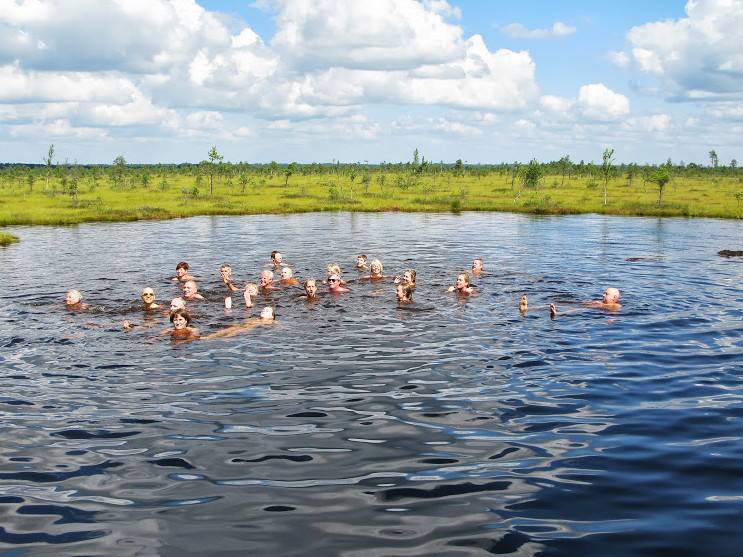
Another half kilometer, and our narrow walkway leads to a platform – I’m thinking “raft” – at the edge of a large pool of black ink. A hole in the sphagnum formed by – – – .  Well, I didn’t ask.

“Swim!” the guide beams like a gracious host.

“Splash” goes Estonian number one. “Splash” the cousin from Sweden. “Splash” the Canadian relative. Why not? “Splash” the Californian.
Image

It’s not surprising there’s nothing substantial beneath my feet. Visions of Bog Man refuse to be evicted from my brain. He’s down below me. He could be me. As I often do, I tell my brain to shut up.

I swim to the opposite bank to see if there’s substance there. Nope. The sphagnum surface just collapses into the pool. You can grab onto some sphagnum if you want to stop treading water for a few seconds, but all you get for it is a handful of dripping moss detached in your hand, and a sinking feeling.

So it’s float, and let the sun shine onto your face.

“A record, it is!” the guide yells. “Never before, zhis many people in zee pool. I take picture.”

Which he does with what he calls his “camera”

“Click” goes his i-pad.

I twirl. Must be 20 of us in the water. Some organized person calls for us to make a circle. Like ducks, we smile and appear comfortable while our legs thrash like crazy somewhere in the dark beneath.

Then someone submerges her blonde head, inverts upside down, extends her leg with gracefully pointed toes, and challenges us to Bog Water Ballet.

Eventually we climb up onto the platform again and devour the contents of the picnic baskets.

“Hot day,” observes an Estonian as I wrap a towel around my shivering self. I’m looking forward to sauna # 2.

We descend the steps from the bog. Katie emerges from the woods, her hands bloody from blueberry picking. Not blood, really. Berry juice. But it gets a few horrified gasps.

I feel a peace about being enveloped again by dense forest. The familiar forest.

Image

“Dust thou art, to dust returneth” was not spoken of the Bog.

October 5, 2013

Estonia: Farms

Filed under: Uncategorized — cbmosher @ 5:28 am

This post on Drugs Sex and Public Health documents observations on a recent trip to Estonia.


Far from the rapidly modernizing capital, a half hour ferry ride across Baltic waters, the island of Saaremaa takes you back 100 years to the fishing and farming past of Estonia.

And, it appears, propels you into the country’s future.

We stand on the north shore of Saaremaa island, facing the Baltic.  A grey sea of water beneath a grey sea of clouds.

Flowers grow right to the water line, whipped by the wind that swirls out of Sweden, across the water, to Vikingize our hair.

Lightning silently flashes the grey clouds translucent. We hear only the washing of waves and humming of pine needles in the forest behind us. A full minute later, thunder rumbles, low and distant, from the horizon where sea and clouds fuse.

The wind suddenly intensifies and almost lifts a boat on the beach. The first thick drops splash our faces.  We turn our backs on the lightning show and head back to the cabin.

From our beds, we listen to the wind blast like the proverbial wolf at our roof of straw. We wince as the sudden explosions of electricity blind our dreams and simultaneous cracks of thunder vibrate the cabin.  We smell, all night, the fresh perfume of pelting rain.

Morning puddles disappear within an hour under the returning sun.  Thick clouds, residuals of the night storm, shadow across the sun briefly and non-threateningly. The day will be available for exploration.

Twenty kilometers down the road, surrounded by broad flat fields of hay, stand three old windmills.  Immobile now, their big blades decaying in the Baltic weather, the mills have been demoted to a tourist attraction.

 Image


Here amid the Estonian farms, horses were given a reprieve in the 1920’s from the work of pulverizing grain into flour when craftsmen built the mills. They are two and three stories high, with wooden gears and twenty foot blades.  There are giant handles on the windmills so they can be turned into the wind.

Everywhere is grass and hay, thick with chlorophyll and fragrant under our steps, irrigated by the Baltic’s weather.  The dependable alternation of rain and sun keeps their rich, black soil producing, century after century.  The morning’s wind snaps at flags and at our clothes.

 Image

Further on, we approach the port (“sadam” in Estonian) to catch a ferry back to the mainland.  Looming above the ubiquitous forest, like some Star Wars invasion machines, wind generators turn slow, powerful revolutions.  Once every six seconds on this day, as they face the Baltic and harvest its energy.

Estonia still gets 90% of its energy in Soviet fashion – from mining and burning oil shale.  This little country has the world’s largest oil shale processing plant and led the world in oil shale production in 2005. Most of the rest is imported natural gas and Nordic hydropower.

But, just as they extricated themselves from Soviet overlording in their social and political lives, they are moving in their own direction with energy production.

Currently wind power supplies 4% of Estonia’s grid capacity (almost the European average) but their goal is 14% by 2020.


Image 

The 2020 target for all renewable energy sources is higher: 20%.  Currently, other than wind, its biomass.  But solar is on the planning boards. If Germany can do solar (it is the leading solar producer in Europe), Estonia’s Baltic weather should allow it, too.

Estonians have always known how to build a farm.  They have what they need for it in their land and their weather.  They are now beginning a new phase: farmers of wind, farmers of solar, farmers who repurpose their biomass.

Estonians have also shown their ability to adapt to other skills and to build for the future (invention of Skype as most obvious example).  They already have built a network of 165 “fast charging” stations for electric cars.

Some of their young visionary engineers are proposing 100% of energy production from renewables by 2030.

Don’t bet against them.


 Image


October 1, 2013

Estonia: The Church

Filed under: Uncategorized — cbmosher @ 4:39 am

This entry on Sex, Drugs and Public Health documents impressions of Estonia from a recent trip.


We did Tallinn for its ancient walled town, surrounded by glass high-rises and electronic gadget businesses.  Women in heels; men in suits.  Metaphoric electricity in the atmosphere, as the country erupts in creativity and capitalism from beneath the fifty years of Soviet domination. Like some spectacular mushroom overnighting on ground previously covered by a cement block. Mercedes, Volvos, and Subarus have replaced horse-drawn wagons.

But the wagons aren’t far away. Now we’re ten kilometers or so from Pärnu, a Baltic sea resort-like town, in a bird-tweeting, horse munching agricultural area where dense forests of birches straddle cleared fields that, judging by the buildings, have grown food for several hundred years. Many fewer English speakers here, and there are no clues within the Estonian language to help you decipher it. Nothing in common with Latin; nothing with German; nothing with Slavic languages, even Russian.

IMG_8062

The commonality is, you might expect, the smiles, the pantomiming to communicate, the straightforward kindness which, for me, recalls my childhood among Polish immigrants in upstate New York.

Trippy (accidental) synopsis of the history of this country tonite.  The accumulated descendants of the Ilja family finish a day of canoeing the river, of lobstering in the sauna, of beer, local fruit wine, dinner, and vodka, by lighting candles and walking to an abandoned near-by church to remember “the dead” (AKA ancestors). Within the dark that finally arrives after 11:30, we approach the “church” and a local explains its history. One of the family members – descendant of farmers, a young woman, and now a lawyer, translates.

The rectangle of thick stone walls and often patched cement was commissioned in the mid 1800’s. The Czar himself paid for it. People came, back then, only because there was a school built nearby to educate the farmers’ children, a gift valuable enuf to them that they began attending the Occupier’s church, too.

Then, in the era of collective farms, it was converted to a different use: storing hay for the horses.

In the 1950’s (Soviet Era) it became a mill for grains and a storage for barrels.

As the Soviet dominance weakened (late 1980’s), the local people began using it to celebrate “The Birth of the Sun” every winter solstice. (Amazing how tenacious Belief Systems are, even crossing generations).

We pull open the crude wooden doors, stumbling in the dark over the earthen floor. Candlelight provides some flickering illumination. Barrels line the sides where pews would be in a western (non-Orthodox) church. “You can sit on the barrels” the translator offers. Everyone chooses to stand.

DSC_0364

A simple stone altar is perched a couple of feet above ground level. Two steps. We place our candles on the first step, in a semi-circle. An eerie symmetry of beauty. The descendants of the Iljas, survivors of the vicissitudes of famine and bad weather, of banishment to Siberia by the Soviet overlords, of feverish scattering from the war, bombs falling on them as they ran, stand silently in the dark church/forage house/mill, watching the candles flicker and erase a hundred years of time. There are Ghosts among the survivors.

DSC_0363

Then someone speaks a few soft words of Estonian, and begins a traditional song. Several join in.

The leader of the song read the lyrics.

On his i-phone.

So, from Russian serfdom, thru turbulent occupation, banishment, and starvation, to the invention of Skype and leadership in the digital revolution: I see the recent history of Estonia and of this family reflected in the interior of that “church.”

Other events are planned for today, but I have no idea what they are. There is no hope that I will learn this unusual language, which seems to have grown from the earth like rhubarb over the centuries. I’m at the mercy of their pantomime and their kindness.

I’m in good hands.

SAMSUNG DIGITAL CAMERA

September 28, 2013

Estonia: The Museum

Filed under: Uncategorized — cbmosher @ 5:12 am

This entry on Sex, Drugs and Public Health documents impressions of Estonia from a recent trip.


Can’t travel to some new place without someone suggesting you visit one.  Walk through halls of stagnant air, staring at a series of inanimate displays whose significance is only marginally brought to life by reading a blurb plastered to the wall.  If you’re lucky, it’s in your native language.

But this one sounded different right from the start.

“Is to show, the KGB museum, how ve lived until only tventy years ago,” the guide says in her high school English.

Tiina had described some of that to me several times before.  She returned to Estonia in the early 70’s to see family members left behind when her mother grabbed her as a two year old and fled on foot, through Estonia, Latvia, Lithuania, Poland, Czechoslovakia, into Germany, escaping the invading Russians.

“Other Estonian expatriates warned me not to return – that the Russians would not allow me to leave again,” she’d told me.

This museum is on the top floor of the Viru Hotel in downtown Tallinn.  Our guide is a young woman in her 30’s, whose personal experience with the Russian occupation, given her age, would have been limited.  The Soviets left in 1991.  But a lot of scars remain.

“Ve go to a floor that doesn’t exist,” she twinkles her eyes, pushing the elevator button for the highest floor.

We get out to see just more rows of hotel rooms, standing like soldiers in innocent order.  She leads us to a staircase hidden behind a door, and up another level.

“Everyone is told, there is nah-sing up here.”

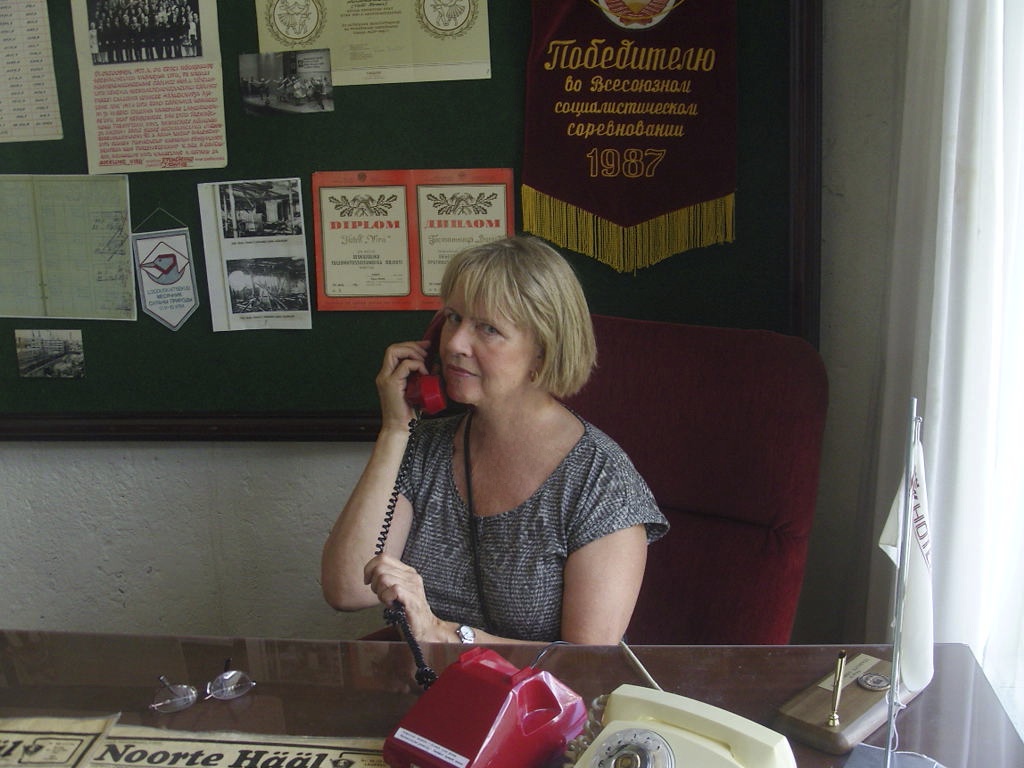
On that level, we find an office for the highest ranking Soviet official, the walls bedecked with photos of Gorbachov and Andropov, and with official proclamations.  Two phones are on the desk.  One red; one white.  Neither has a dialing plate.


SAMSUNG DIGITAL CAMERA


“Direct to Moscow, this line,” she points to the red.  “Into the spy room this one,” she indicates the other.

Down the hall is another door.  Estonian words on it are translated by the guide.

“Zhere is nah-sing behind zhis door.”

She churckles.  “Ve write zat to make fun of zee Soviets because, they always said zhat.  No sign on door in Soviet times.”

Inside are banks of archaic electronics.  Large radios occupy several of the spaces.  An old reel-to-reel tape recorder occupies one space.  Wires spiderweb the ceiling.  Headphones and ashtrays on a small metal desk were hastily abandoned in 1991.  Half smoked cigars included.  A white phone on the desk twins the one in the officer’s desk.

“If you vanted come to Estonia, you may stay only at zhis hotel.  Fifteen percent of the rooms in hotel were bugged with microphones and cameras.  Certain people are always assigned to one of zhose rooms.  Can you guess who?”


DSC_0299

“Spies.”

She laughs.  “Yes, I suppose.  If James Bond makes reservation, he gets bugged room.  Who else?”

We shrug.  Even Tiina.

“Journalists,” she tells us.  “Soviets vere very paranoid about reporters.  And also, Estonians who return from other countries.  Is anyone here Estonian from elsewhere?”

Tiina raises her hand.

“Did you ever come back in Soviet times?”

“Oh, yes,” Tiina acknowledged.

“Zhen, you stay in zhis hotel.”  It was not a question.

“Yes.  We did.  This hotel.”

“You get bugged room,” she picks up a set of headphones.

“We assumed that.  My family said that we only talk freely outdoors, in the park.”

“Yes,” the guide smiles.  “Everybody knows zhis KGB is here.  Is – vhat you call?  ‘bad secret’.  Bad kept secret.  Vunce, journalist comes into room, looks around and says to wife, ‘Look.  No sheets on the bed’.”

The guide smiles.  Pauses.  Continues.  “Zhen comes knock on door.  Zhey open.  Is maid wiz sheets.”

We chuckle.  Easy to chuckle now.


SAMSUNG DIGITAL CAMERA


“On every floor zhere is grandmother in chair by elevator.  Why, you tink?”

Tiina recalls.  “They marked down every move you make.  How long you’re in the room.  Who’s in room with you.  How long you’re gone.”

“Correct.  Zhey report everyzhing.  But in store, is very little food.  No toilet paper.  Is very hard in Soviet times.  So vhat you tink happens?”

Tiina again.  “We gave the grandmother gum and cigarettes, and then she sees nothing.”

“Correct.  You know zhis very well.  Know vhat else you can give which, like a great gift, is appreciated?  Plastic bags from Finland.  In zhose days, Estonians carry plastic bags like Gucci.”

We chuckle, uneasily.

“You vant taxi, vhat happens?”  She’s still looking at Tiina.

“Black taxi.  We only get the black taxi.”

“Yes.”  And tell group, vhy is zhat?”

“They only wanted outsiders to see certain parts.  Only the good parts, paved streets, clean houses.  So we’d think all of Estonia was like that.”

“Correct.  And never can you leave Tallinn.”

“We did.”

“Ja?!  You did?  In 1970’s?  Tell us how.”

“I came to see my grandmother.  She lived in Tartu.  They told us Tartu was closed.  ‘Closed?’  You can’t ‘close’ a city.”

“Soviets can,” the guide adds, urging Tiina to continue.

“ ‘Bullshit’ I said.  I came to see my grandmother.  She survived Siberia, but she wouldn’t survive old age.  I was going to see her.  One of my family here spoke perfect Russian.  He had us dress up like University students, and never speak.  Not even me.  Because my Estonian was different.  We got on a train and went to Tartu.”

“And?  No problems?”

“Some problems.  A Soviet officer came up to my husband, who was wearing a student’s cap, and began to speak to him.  Raul, our cousin, came running and took over.”

Carried by the emotion of her memories, Tiina lapses into Estonian.  The guide translates:

“Zhen, she says, returning, zee shoes were all muddy because zee streets of Tartu, streets of University city, not paved.  Zhis streets of mud is vhat the Soviets don’t vant you to see.”

“So,” Tiina resumed in English, “we had to take paper and wipe off the mud to get rid of that evidence before we got off the train in Tallinn.”

“But you not use toilet paper,” the guide added.

“No.  There was no toilet paper.  Not anywhere we went.  Except the hotel.”

“And zhis is vhy zhere is no pages in phone book, anyvhere you go, too,” the guide added.  “You have good stories,” she thanked Tiina.  “I use your stories to help ozher people understand how it vhas.”

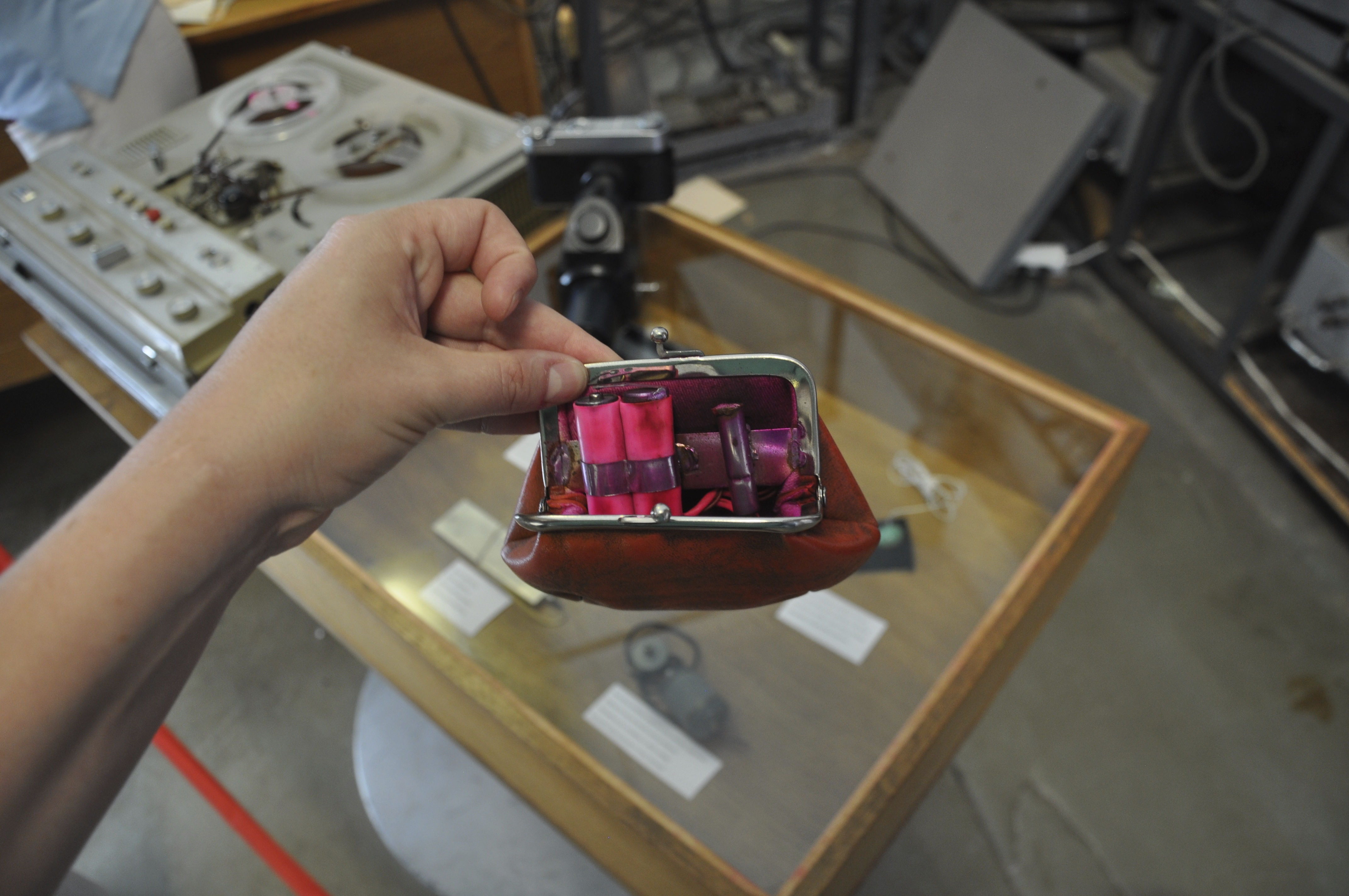
She picked up a small ladies’ pocket purse.  Held it up.  Snapped it open.  Inside was a small cylinder smeared red.

“Vhat is, you tink?”


DSC_0294


We all guessed wrong.

“Soviets vanted all hotel employees to be honest.” She ironied.  “Zhey put purse in room.  If employee opens to take money – because in zhose days rubles are vorth very little – zhis is dye.  Employee is covered in red dye.”

Even James Bond, I think, would find that way too hokey.

“So, the Russians are gone, now?” a Canadian tourist asks.

Our guide shakes her blonde head.  “Not gone.  Soviets are gone, but not Russians.  Twenty-five percent of people in Estonia now are Russian.  During Soviet times, many Russians came to Estonia to take all chobs.  In Soviet apartments, zhey lived.”

I’ve seen these, in every city.  Amid the beautiful old wooden homes and shops of the Estonians are concrete rectangles, built in the 1950’s and 60’s, already crumbling, paint peeling.  It’s easy to find the Soviet housing.

“And, the Russian language you must use in those days.  In schools, in business.  But now, since Independence, Estonian is our language.”

“Your English is very good,” the Canadian compliments her.

“Ja.  Estonian and English ve learn in schools now. At home only, it is different. There I speak Russian.  My mother and father they are from Smolensk.  But outside my home, I speak only Estonian and English. No more Russian we have.”

Just scars.  Healing scars.


September 19, 2013

Three Tallinns

Filed under: Uncategorized — cbmosher @ 2:05 am


To many of the tourists disgorged from cruise ships at Tallinn’s sadam (port), this city’s “Old Town” is Estonia.

But to the residents of the capital, most of whom live, work, and play in modern Tallinn’s towers of glass and chrome, sprawling malls, and department stores, Old Town is a tourist attraction, good for the economy, but a crowded place to be avoided. It is also, however, a source of pride as a spectacular monument to their history.

There are other reminders of their history, at the outskirts of the capital. But most Estonians might see those as a receding nightmare.

Think of semi-circles, facing the sea.

People have lived in the forests and bogs of Estonia’s interior for 10,000 years, archeologists document. Sometime around 1000 C.E. , some of them began construction of a city on the shore of the Baltic, surrounded by a wall for protection. From the mists of the forests, a verbal history condensed into legends which surrounded the city like its walls. Kalev, a giant skilled in making trees into buildings, built the city and is buried beneath its hill. His grieving widow carried hundreds of boulders to cover him and create Toompea hill over his grave.

Old town is northern Europe’s best preserved Medieval walled town. The teeming commerce in tourists within it has not erased the spectacular architecture that evolved from Kalev’s fortress, from the occupation by German crusaders, then German merchants of the Hanseatic League, then Danish ownership, then Swedish overlordship.

3440904513_43cbe30e29

Grown up outside the walls is modern Tallinn, careening forward to not just join, but, perhaps, to lead twenty-first century Europe. Their across-the-water neighbor, Finland, has assisted from the moment Soviet occupation was driven from the country by the “Singing Revolution” in 1991. They invested early in the city with a major department store and since with electronics, plastics, and wood products.

Deep into the digital revolution, Estonians have created free WiFi countrywide, a national network of cell phone connectivity facilitated by the flat topography, and the invention of Skype. They provide their citizens free public transportation and Scandinavian style Health Care.

DSC_0883
But lurking gloomily beyond these two Tallinns are the rectangular cement structures the Soviets call “apartments” which were constructed during the occupation from 1944 to 1991. Architecturally contemptuous of the city, they are the hub of what has grown to house 25% of Estonia’s current population: Russians.

SAMSUNG DIGITAL CAMERA

The Estonians demonstrate much more tolerance toward their former occupiers, jailers, and torturers than the Soviets manifested against the inhabitants of the country. The Russians were not expelled, and certainly not exiled to Siberia, but are now incorporated into the society. They must, however, use the Estonian language for commerce.

You can feel how these powerfully different social forces do not just co-exist – they have intermingled to form modern Tallinn.

Tomorrow we begin our exploration of the country’s interior. We’ll see how well these same forces have consolidated into a modern Estonia.

« Newer PostsOlder Posts »

Blog at WordPress.com.