Sex, Drugs, and Public Health

February 14, 2014

DAY FIVE AT SEA

Filed under: Uncategorized — cbmosher @ 1:44 am

Kayaks vs Icebergs.

The ship anchors in a bay, and we take an inflatable kayak out. Sarah sits in the stern, controlling the rudder with her feet and taking photos. I take the bow and the paddle.

Steep black rock pinnacles separated by blindingly white glaciers with 100 foot high walls surround us. In keeping with the color scheme here, the ocean water looks black. A mirror. Ice floats randomly over the surface. No two chunks are shaped similarly. The sea water has sculpted them into parallel grooves, pock-marked faces, tall spires, ovals, and delicate crystal filamentous transparencies finer than Waterford.

We paddle among them, the small ice pieces clinking against each other, the entirety of these thousands of near-the-end-of-their-lives ice chunks tinkling like wind chimes. We paddle around the medium sized pieces – those the size of semi trucks. The ones that draw us to them, but from which we keep a distance, are the spectacular ones: chunks the size of apartment buildings with caves eroded into them, with deep turquoise hues, glowing translucent, beckoning with their magnificent beauty.
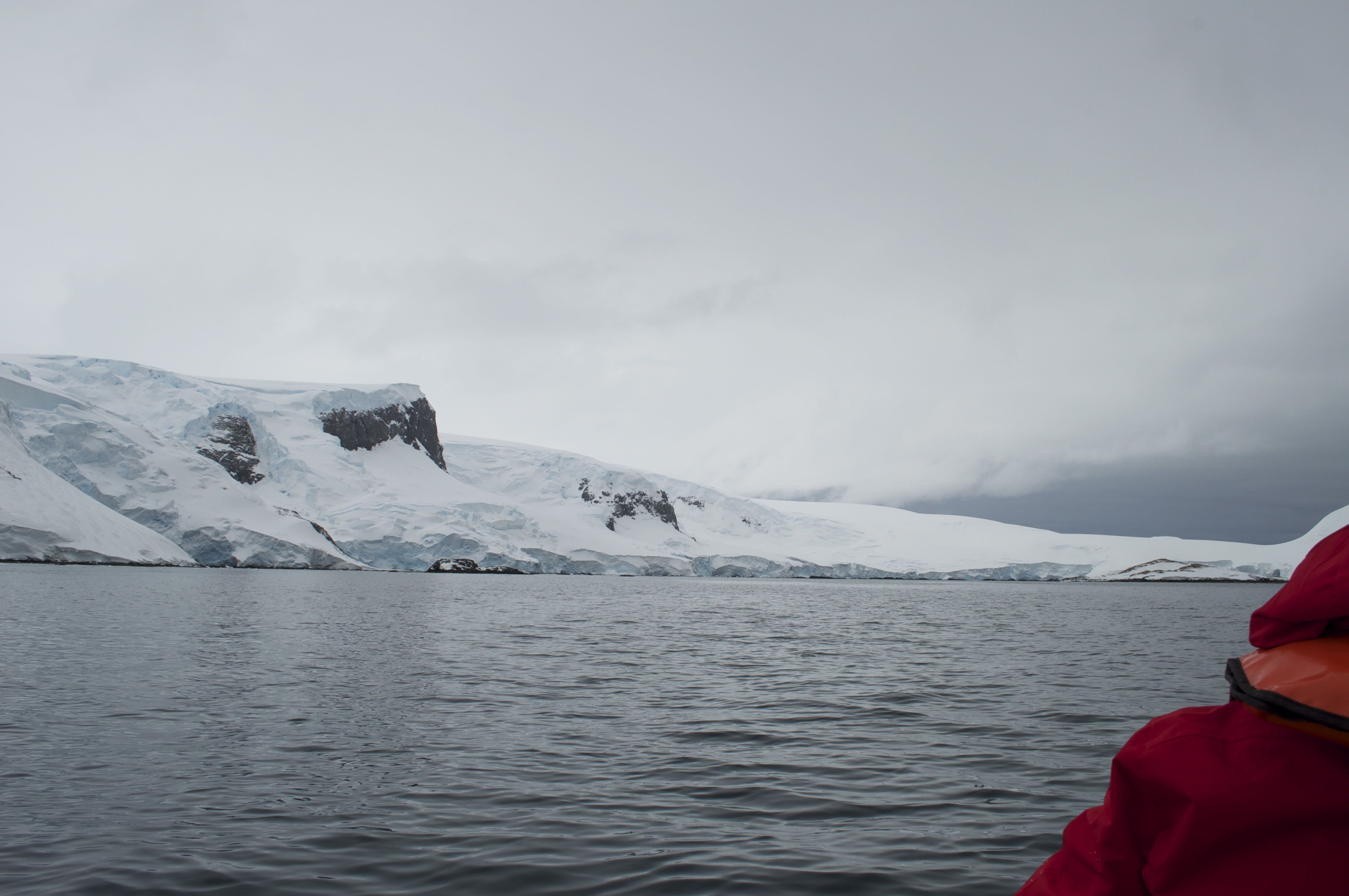
 5 Kayak

There is a grumble, and a sharp crack. My eyes shoot toward the glaciers, looking for a new calf falling. None. Then I see it – a berg is rolling over. Flipping. Its groan echoes over the water, a large wave launches from its splash. Now a part of the 80 % of the berg which had been underwater is dripping above the surface (a new shape) while what had been the berg we’d seen, is now submerged.

Which is why we keep our distance from these beautiful monsters. Even if it didn’t hit us, the wave could swamp us. I look down at the water – black. Like ink alongside the kayak, aquamarine translucent at the edge of the bergs. Would NOT want to go into the drink. They’d try to get to us quickly, but – – – it’s minus one degree, Celsius.

Later, on the ship, the Underwater researcher shows us the movie she and her partner made on a dive the day before. It dramatically reinforces the life cycle here. The bottom is dense with Life: sea stars, urchins, tunicates, cucumbers, and thousands of small, drifting plankton completing the soup. She had to wear a dry suit, of course. Wetsuits, such as Sarah and I used in Monterey when the water was 50 degrees F. would be grossly inadequate.

Ship’s intercom: “those taking the Polar Plunge, put on your suit and report to the Mud Room.”

Hallway conversation:      “are you doing the Polar Plunge?”

                                          “I don’t know. You?”

                                           “Haven’t decided yet.”

The Mud Room has the open doors accessing the ocean three feet below. For getting in and out of Zodiaks. And kayaks. For SCUBA folks. There’s a step and a ramp – but it’s not a pier. All the Peer here is Pressure.

Internal thought:    Minus one degree.

Line up. Take off your robe. Up the step.

In goes Sarah. Out comes Sarah with the wide eyes and open mouth of shock.

Down onto the pontoon boat. Oh, look. Guys are going to film this. They’re in the water.

In dry suits.  Not one inch of skin showing.

Minus one degree.


Don’t think, just go.

Splash!

Black.

Surface.

Breathing muscles paralyzed.

Now we’re penguins.
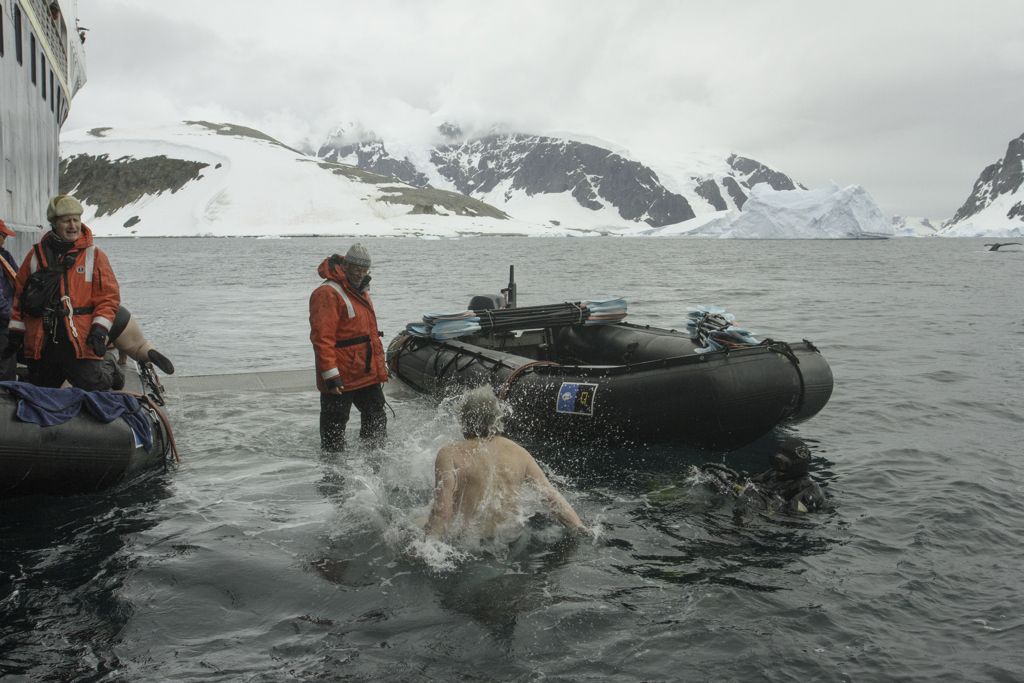
5 Polar Plunge

February 12, 2014

DAY FOUR AT SEA

Filed under: Uncategorized — cbmosher @ 9:54 am

Lying in the shallow ocean water, just beyond the beach where penguins stumble and trip over pebbles, is a bone. It’s a rib. The rippling water distorts it to our eyes, but it can’t distort this: the rib bone is twelve feet long.

Late 1700’s, to mid  1900’s (Yankee whalers were working Antarctica in 1791) , they slaughtered whales and brought them to this beach to take the oil. The rest they dumped. Whale populations fell to low single digits of what they had been for centuries before. Wasn’t til after WW II that pressure from those who care (the term “environmentalist” didn’t exist yet) slowed, and eventually halted the slaughter. (Well, almost halted it. There’s still one country that hunts here “for scientific research.” A loophole in the international agreement).

SAMSUNG DIGITAL CAMERA

In this place, where there’s almost no Life on land, where it occurs beneath the ocean’s surface, sightings of whales became rare. Even within the lifetimes of the scientists who take these voyages with us paying customers, a whale sighting might occur only once every four voyages or so.

But we’ve seen both Killer Whales and Humpbacks off our bow the past two days, and yesterday we got a whole lot closer.

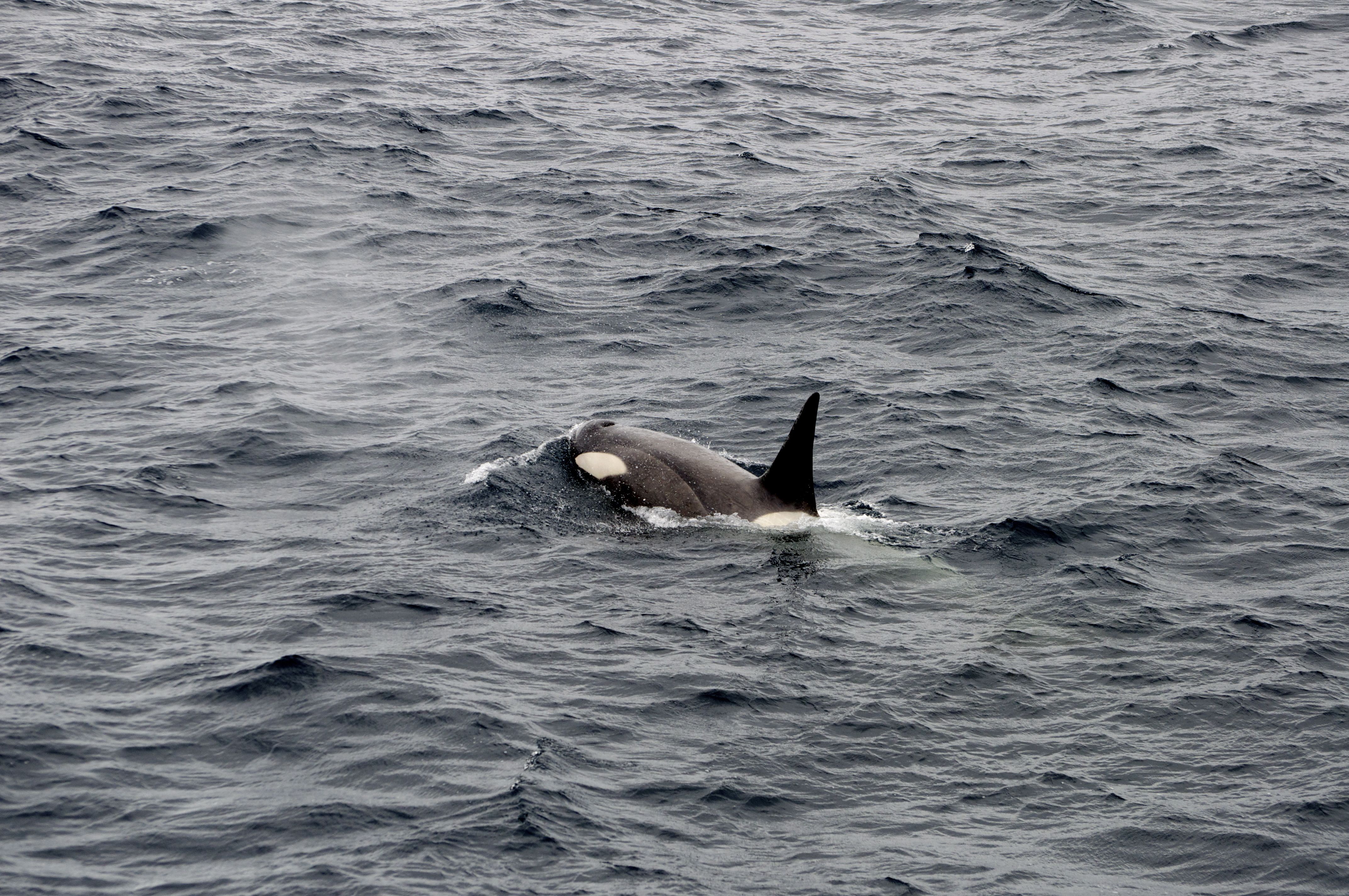
The Killers – species name “orca” – are easy to spot by their paint job. They all must surface to breathe – exhaling at 200 miles an hour and exchanging CO2 for oxygen in their lungs at an efficient 85% (our exchange efficiency is 20% or so for a single breath). But the scientists have found some substantial differences, using study tools of cameras and crossbows. The whale’s dorsal fin breaks into the air with each breath, and if the scientist’s boat is close enuf, his arrow plants a temporary tracking devise on the fin. Did that yesterday.

This way, they’ve found three groups – the Killer Whales in each group have different patterns of coloring, they hunt in different areas of Antarctica, and they eat different prey. One prefers seals, another a single species of Antarctic fish, and the third eats other whales.

So, they no longer call these whales “Orcas.” They believe that there are three or four different species of Killers, and the taxonomy must change. Only one of the four will keep the species name “orca.”

Twice now we’ve seen a half dozen Killers within reach of our eyes.

4 Killer Whale

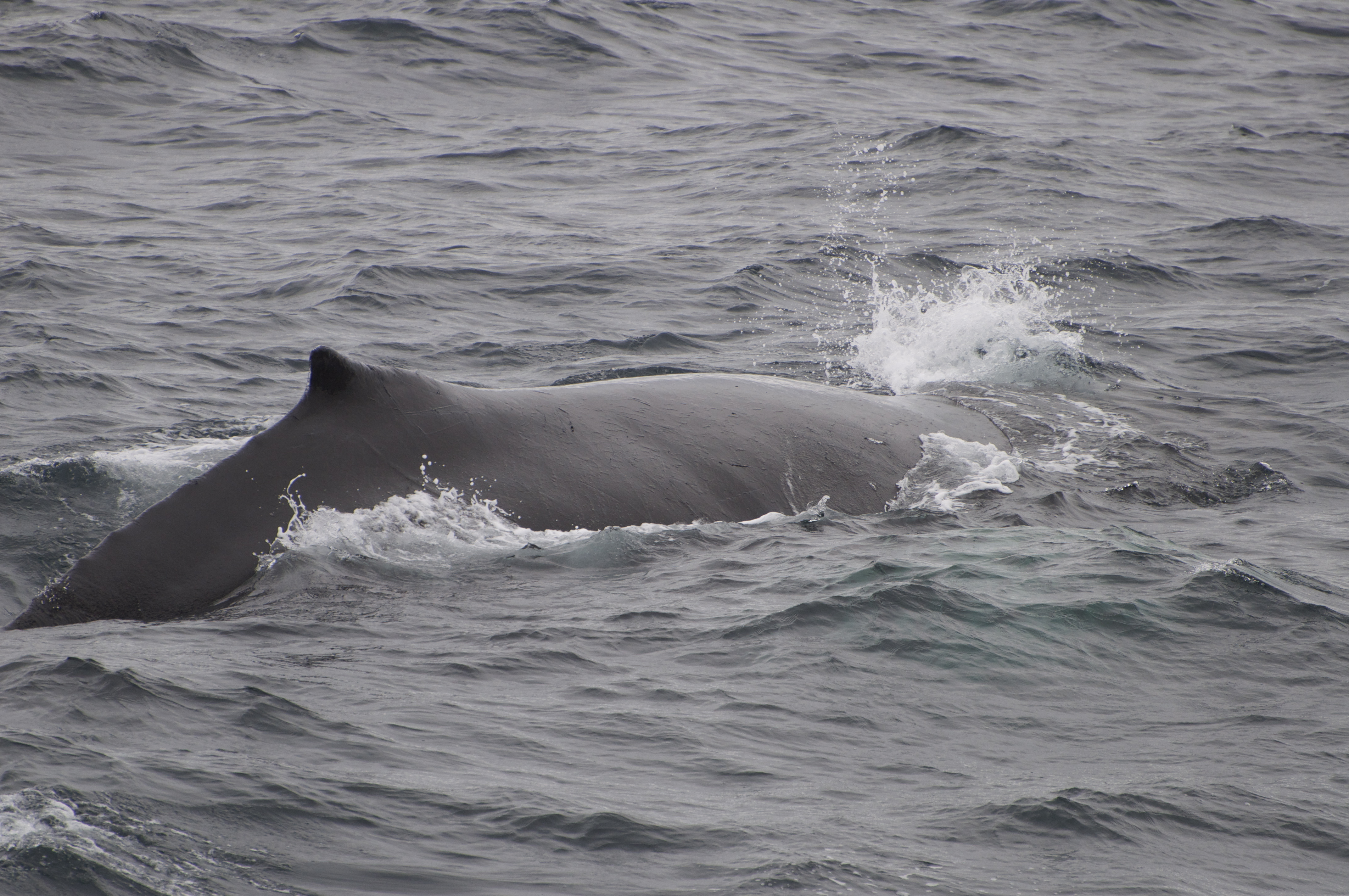
Two nites ago and again yesterday when our ship followed a blow, geysering from the water, the animal whose spine curved out, up, and back below the surface was much larger than a Killer’s. Like a fat submarine, black Humpbacks surfaced to breathe while feeding. We could predict where they’d surface again by the bubbles breaking the surface.

When these whales find their preferred food, they often get below their prey, swim in a circle, and blow bubbles. The rising cylinder of bubbles acts like a cage, trapping their prey. Then they open their mouths and swim up thru their cylindrical trap, engulfing everything in there. Using their one-ton tongue, they squeeze out the water from their mouths, and swallow.

Ironic that the bigger whale (up to 50 feet long and approaching 50 tons) eats stuff that’s smaller than the Killers’ prey. Much, much smaller. They eat krill – a 2 inch long shrimp-like animal.

Yesterday we cruised a bay here, in the Zodiac, and a mother and calf, probably just weaned from her very thick and rich milk, surfaced and blew nearly within arm’s reach of our inflatable 22 foot boat. Reminded me of standing on friend’s 40 foot sloop in San Francisco bay, as a Chinese container ship passed by us, eclipsing the sun.

In that bay, dense with floating bergs, we saw at least a half dozen Humpbacks in less than an hour. Good news for species recovery after teetering on extinction’s cliff.

DSC_0204

The food chain here is real simple. Diatoms (some of you may know “Diatomaceous Earth,” the shells of these microscopic phytoplankton) bloom in these nutrient rich, very cold waters. The krill eat the diatoms as long as the water temp is colder than 4 degrees C. ; penguins feast on krill; seals eat penguins; some whales eat seals. Other whales, like the Humpback, by-pass intermediary steps and eat krill directly. Up to a ton of it a day.

Tommorow – diving in the Southern Ocean

February 11, 2014

DAY THREE AT SEA

Filed under: Uncategorized — cbmosher @ 2:09 am

Sunrise. Three-thirty A.M.

We’ve been steaming all nite, passing thousands of icebergs, and are only now entering Antarctic Sound at the tip of the Antarctic Peninsula.  We’re still over 1,000 Km. from the mainland.

Off Starboard are black mountains smothered in snow. To Port, is a very large chunk of ice: either Joinville Island or Dundee Island. When closer, I see that it is flat on top. Like a landing strip. And its edges are straight as the walls in a house. Looks like a perfectly sawed-off rectangle of ice, floating leisurely.

3 Tabularberg wide

A scientist, up as early as I, says that it’s a Tabular iceberg, some of which can be several kilometers long, and several more wide.  Snapped from – not a glacier – but from one of Antarctica’s gigantic ice sheets.  From my reading,  I realize that what we see – a berg as massive as a small city – is only the 20% that is above the water line.

Unlike the traditional glacier-spawned bergs, this one will live for years, perhaps decades. It will float free until the 80% below waterline snags on the bottom, and remains stuck there. It’ll be a place of refuge for penguins, other birds, and seals.

On the Bridge, I check the digital charts. We are now south of 63 degrees, well inside the area designated “Antarctica,” but still 400 Km. from the Antarctic Circle. I go outside on this Summer morning to photograph the tabular berg, and the wind slices me like razors. Colder than a doctor’s stethoscope. Minus 8 degrees Celsius. I don’t stay out long.

The enormity of this continent is beginning to sink in. We’d have to steam another two days to reach the edge of the circular ice cap that encases the round mainland.

3 Tabular berg

As for Life, from the ship I see no birds, no mammals this morning. Just low grey clouds, rocks, snow and water. Feels like certain death from freezing, even in Summer.

And in the early morning:   silence.   Mystical, spiritual silence.

Here’s an interesting way to look at the difference between the two Polar regions:

Antarctica is a continent surrounded by water; the Arctic is water (frozen) surrounded by continents.

Entirely different ecosystems. The Arctic has over 700 vascular plants, including forests. Antarctica has two. Maximum height here is under three inches. No Polar Bears here, No land mammals, really. All the life here is dependent on the sea.

First trip ashore.  We dress to stay warm and to stay dry. Funny-looking Pillsbury dough-persons, all in red parkas. The penguins will, no doubt, laugh at us. Into the inflatable Zodiacs, trying to cling to both the boat and our cameras, we bounce over the waves to a beach for which the adjective “desolate” would be an absurd understatement. We dis-embark into the water, and wade onto the pebbles. Into the penguins. This place is their breeding colony. Several hundred of the birds waddle about. The majority are moulting fledglings, chasing adults, yammering for food. That yummy regurgitated half-digested puke of fish and krill which they eat directly from their parents’ mouths.

3 Adeile Penguins

It’s been nearly 50 days since the eggs hatched, and now the remaining down of the chicks is nearly all plucked out, replaced by their waterproof feathers (unique among birds) and it’s time to hit the 3 degree water. To learn how to swim, catch their own food, and avoid leopard seals.

They already have other predators, as a skeleton of a chick on the pebbled beach attests. Skuas. A species of sea bird known to drool over penguin chicks and who can even hold a stolen egg in its beak.

You who hear the word “penguin,” and think of either Nat’l Geo documentaries or cartoons entitled “Happy Feet” have not had the full experience. You missed the smell. Penguin feces come in two colors: red means eating a lot of krill. White reflects a fish diet. There’s a carpet of it here.

They scamper back and forth at the water’s edge, unsure who to follow, but always following someone: clumps of several dozen birds waddling back and forth, stumbling, face-planting, flailing comically with their flippers, testing the water, then scampering back to shore. Finally someone wades in, ducks his head into the surf, and becomes one of the most powerful, aerodynamic, and fastest swimmers among birds. Like a SCUBA diver, their cute clumsiness evaporates at the water. (Now I’m anthropomorphizing, too. Drat!)

All the other chicks in his gang follow. Twenty yards or so from shore, one of them has his first (and last) encounter with a leopard seal. But the gang is large, and penguins are one of the most successful species here. Mother Nature likes the sheer numbers approach.

We steam into another bay. “Whale!” someone spots a blow. I put down the camera, watch, and see at least a dozen separate whale blows. Seals frolic off our bow. The density of seabirds has increased tenfold.

Then this day morphs into a display of the Life here. Life I couldn’t see in the early morning. Seals, birds, two kinds of whales. And the ocean-based critters which sustain, in pretty robust fashion, everything up to 50 ton whales.

Next time: Killers and Humpbacks.

February 9, 2014

DAY TWO AT SEA

Filed under: Uncategorized — cbmosher @ 10:40 pm

February.


The height of Summer in the Southern Hemisphere.  100 degrees in Buenos Aires a couple of days before we departed.


Now, Snow.


The ship is driving directly into a snowstorm with 35 knot winds. Big swells and whitecaps raise the bow, slide beneath us, and we crash down into the trough. Grey clouds and fog right down to the surface of this ocean.


Icebergs. They begin to flow by. Little ones. They are the first hint of land hidden beyond the fog. Then, a monster drifts past us, glistening white in the turquoise ocean. It is the size of a city block and as high as a four-story building.


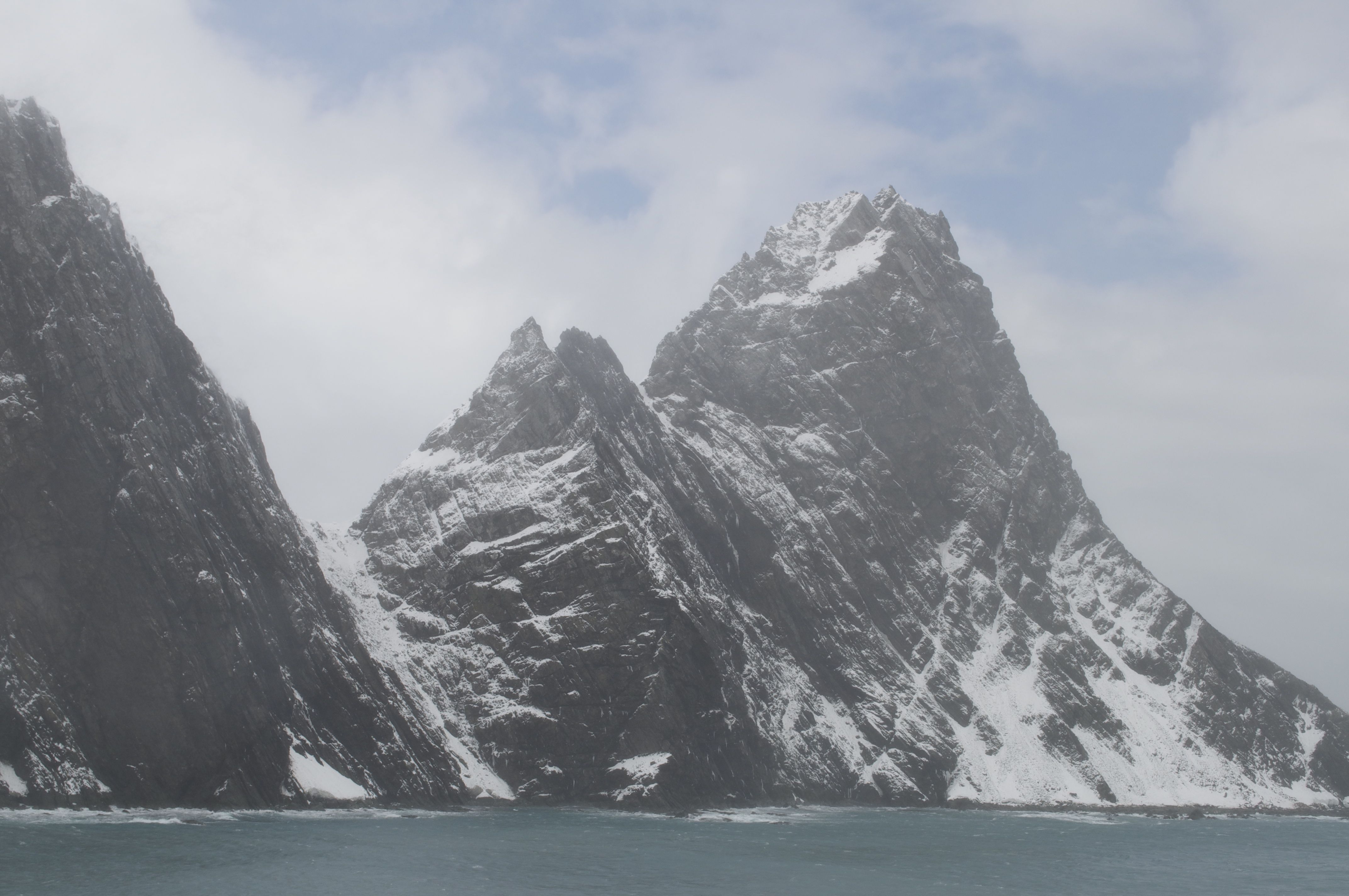
From the low clouds and fog, shadows emerge. Land. First land in 36 hours. Barren mountaintops erupting from the water, black at their tips, blindingly white down to the water’s surface. No trees. No plants. No soil.

2 Elephant Island

Between two conical mountains, a vast river of ice squeezes toward the water. It is at least 100 feet high and variously textured: white like meringue snow, with deep fracture lines; pockets of deep blue ice scattered within.


BANG!   Cr-r-rr-ack!   SPLASH !


A new iceberg.


Out on the deck, the wind blows so strongly, we need to grip a railing, feet into a wide stance, leaning into the wind. Only one arm remaining for the camera.


This is Elephant Island, named for the seal. But made famous by different mammals.


In 1915, Shackleton  launched an assault to cross the continent on foot via the South Pole. He divided his men into two groups, positioned on opposing shores of the continent. Over-wintering should have been a time to rest, eat, and plan details for a Summer assault. But Antarctica had different plans for them, which included first trapping their ship in ice, then crushing and sinking it.


Shackleton and his men from the Weddell Sea party salvaged three lifeboats, and once the ice unlocked the ocean beneath it (fifteen months after the ice had first grasped them), they sailed 250 Km. to this island – Elephant. Shackleton took off in one of the boats, hoping to obtain help from a whaling station 1280 Km. away, leaving his men to survive on seals and penguins. They “camped” here for four months, beneath overturned lifeboats, during the sun-less depths of Winter.


In vain my eyes search for a place hospitable to camping. In the Summer.


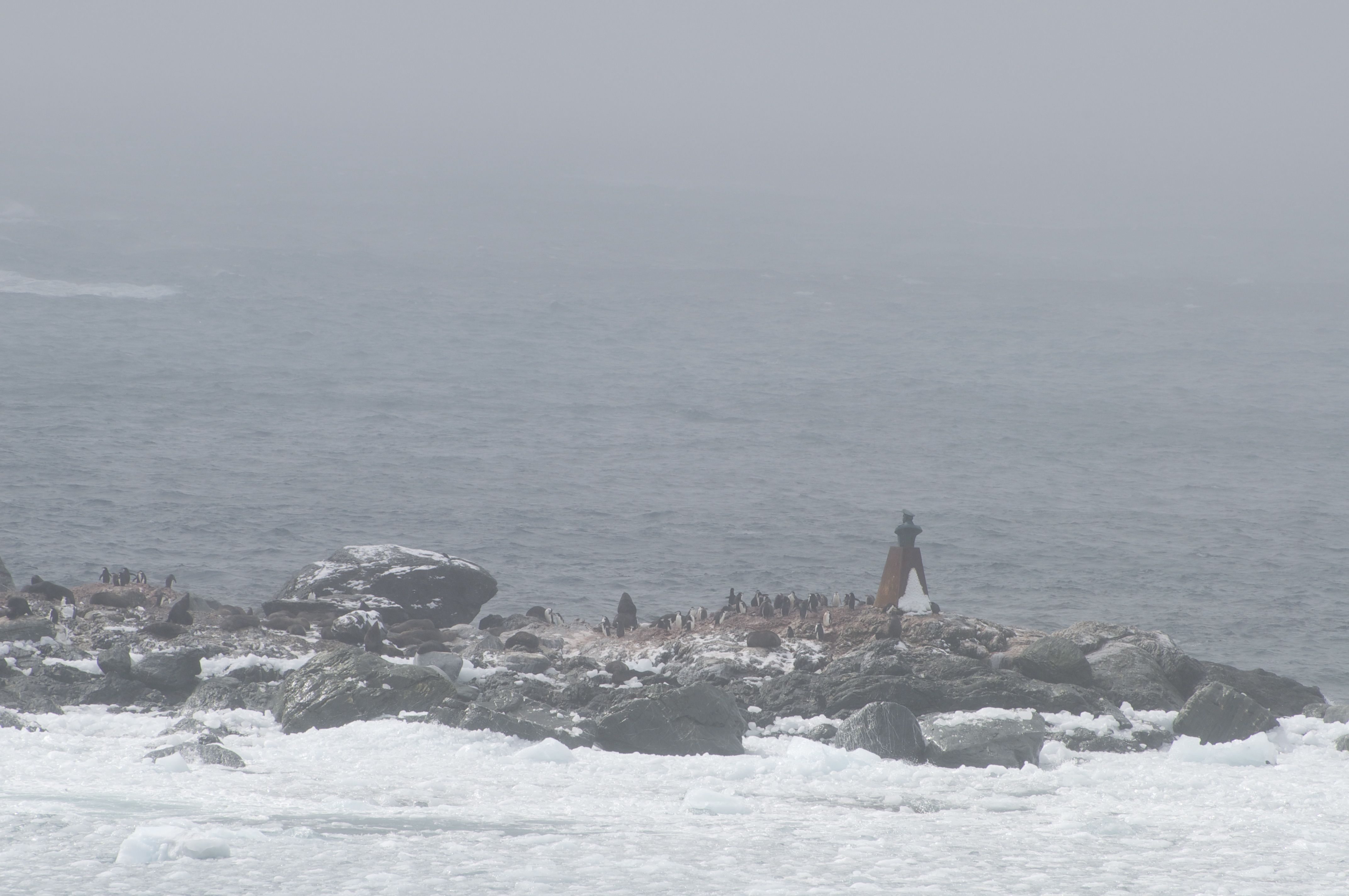
On his fourth attempt, Shackleton rescued his men from this island. There is a monument.

2 Shackleton monument

The rest of his men were positioned on Ross Island, hauling supplies for Shackleton’s cross-continental trek. Their ship, too, was carried away by ice. So, they over-wintered there, losing all but seven men from that crew.


I’m stirred from this reverie by a shout.


“Penguins!” someone yells and a dozen guests flock to that side of the ship. A couple of the iconic birds surface from the sea, but most meander over a jutting peninsula of low guano-covered rocks. Beyond my camera and eyeballs, it’s telephoto range. I trust Sarah to cover that.


I expected to be ho-hum-yeah-that’s-nice about it, but as these black and snow-covered mountains emerge from the fog, my eyes tear up from the overwhelming untouched beauty: barren and powerful, lonely and storm-lashed, defending continent of one of our two poles. Like a loyal bodyguard.


We can’t land because of the weather, but what’s out there, just beyond the ship’s railing, is magnificent to see.


DAY ONE AT SEA

Filed under: Uncategorized — cbmosher @ 12:26 am

1 lifepreserver

Where the Pacific and Atlantic collide, their violent offspring is the Southern Ocean. Our ship ploughs thru its westerly waves and winds, weaving a zig-zag as she is pushed to the east, then auto-corrects back to the west. Our wake is a line as sinuous as a snake swimming the surface, driving relentlessly southward, toward Elephant Island.


DSC_0051

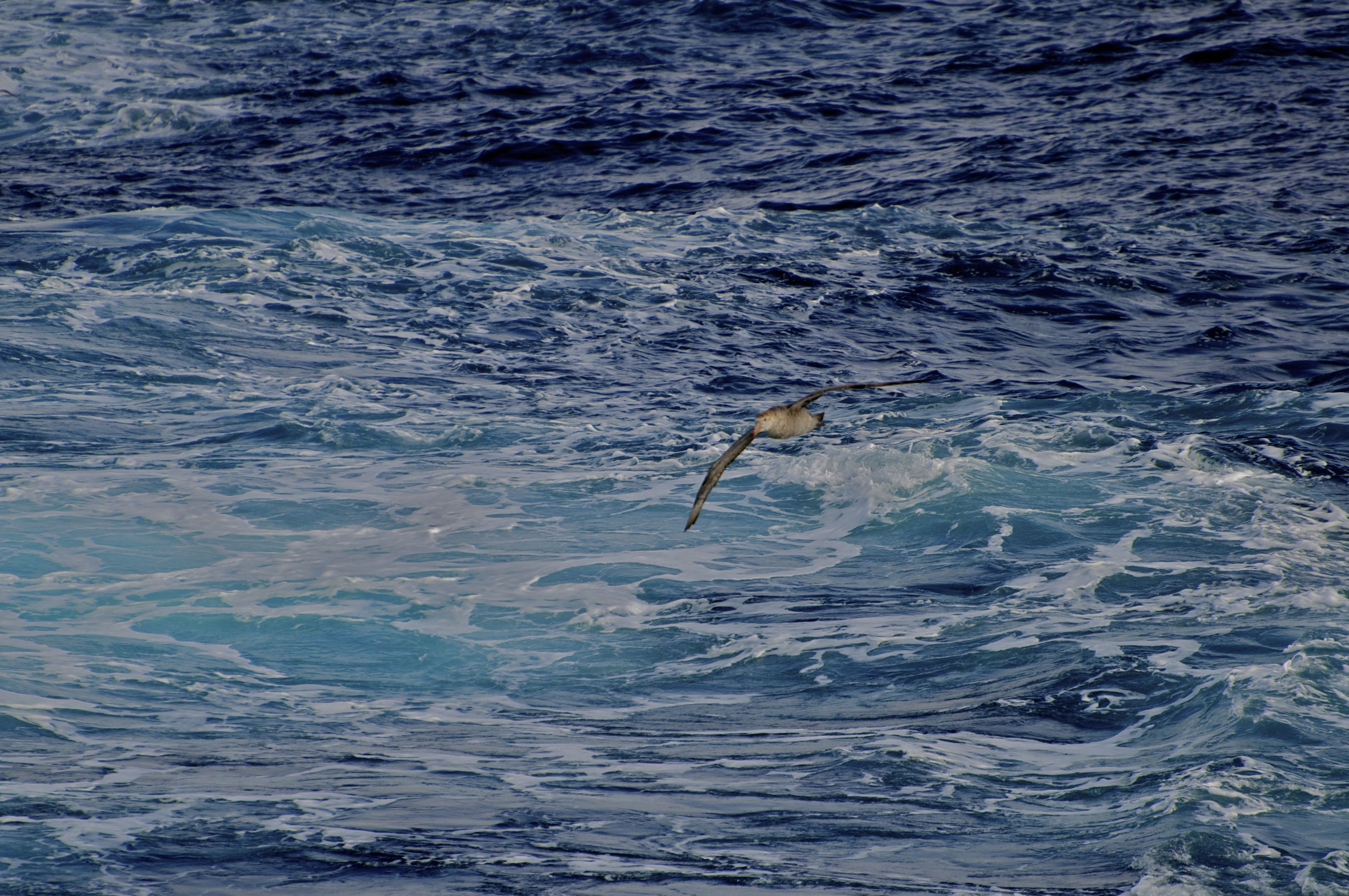
Albatrosses, with heads the size of a man’s and a ten-foot wingspan, swoop the turbulent waves, gliding, turning, smelling for food. The Ornithologist on board says that these pelagic birds remain on the wing, day and nite, in all weather, for up to two years between breeding on land to raise a chick, then return to the open ocean. They seldom beat their wings – they are gliders. They can live to age 75 years.

The control room on the Bridge of this 367-foot ship is fully digitalized – not much technology there which I could use to drive a boat. The ship, the National Geographic Explorer, has on-board a reverse osmosis plant to produce water and store up to 33,000 gallons. All wastewater is treated to secondary level, then discharged.

Staff on board includes a SCUBA diver, Ornithologist, Marine Mammal experts, an Antarctica Historian, an expert on Ice, and several professional photographers in addition to the ship’s crew, stewards, waiters, and cooks. They come from Sweden, the Philippines, New Zealand, Britain, the U.S., France, and Oregon.

We  are making 15 knots and have nearly 1,000 kilometers to go.

Sarah’s connected with a Nat’l Geo professional photographer, and is turning out some great shots of sea birds and the ship.

1 Albatros

« Newer PostsOlder Posts »

Blog at WordPress.com.