Sex, Drugs, and Public Health

November 13, 2010

HAITI IN THE TIME OF CHOLERA

Filed under: Uncategorized — cbmosher @ 6:32 pm


The set-up was there.  In April, when I was in Haiti with a medical team, this is what I saw: people living in tents pitched on the rubble, in city parks throughout the capital, even on sidewalks; Streams of foul smelling waste water flowing through the streets, right past people, tents and food stands; Kids in clean uniforms walking to school, crossing these polluted flows.

There are dozens of tent camps, with hundreds of tents all crammed next to each other, both in the capital and along the road leading north, to St. Marc.  I saw very few portable toilets among the tents.

In Saint Marc, the city north of the capital where we conducted clinics, the major river was a thick brown color.  The irrigation canal, which serves that area, roiled with brown foam and floating garbage.  I watched children swim naked in the canal, and women scoop water from it.

The bacterium that causes cholera is very unique.  It can live in both sea water and fresh water.  The disease is endemic in the waters of India, but had not been seen in the Americas for decades until it exploded as an outbreak in Lima, Peru in the early 1990’s.  My family and I were in Bolivia at that time, and Public Health officials were working feverishly to prevent its spread to the tropics.  The fear was that people migrating from the mountains near Peru, down to the tropics, would bring the disease with them (they did).

In addition to building protected water systems and closing lakes to bathing, the local hospitals built special beds in a separate “cholera ward”.  These beds were merely cots, with plastic covered mattresses that had a hole in the center.  A patient with cholera is placed, naked, on the mattresses with his buttocks over the hole.  A bucket is slid under the cot to catch the diarrhea.  A cholera patient may lose up to ten quarts of water a day.

The hospital’s storeroom was stocked with bags of IV fluid.  Cholera patients die of dehydration, not infection. So the goal was to replace the volume of lost diarrhea fluid with an equal amount of IV fluid, and prevent dehydration.

In Haiti, the people know their water resources are polluted.  So, when they can afford it, they purchase water.  It comes in small, sealed plastic bags the size of your palm.  But on the plane bound for Haiti, an elderly Haitian woman in a flamboyant dress told me:   “doze bags of water, don’t you drink dem.  Bad.”

When people carrying the cholera bacterium within their intestines, come from St. Marc to Port-a-Prince to visit relatives in refugee tents, it’s gonna be a catastrophe.

As before, for any of you who want to help, I’d advise you contribute to Partners in Health.  They are a competent medical organization that has been in Haiti for over twenty years.  They will help the ill.

That will have to suffice until Haiti’s Public Health Ministry can, someday, separate the water from the sewage.
October 25, 2010

Filed under: Uncategorized — cbmosher @ 6:55 pm

October 24, 2010

Going to Hades – – –

Filed under: Uncategorized — cbmosher @ 6:41 am

– – – is how a colleague mis-pronounced what I’d said.

“Haiti,” I corrected. “I’m going to Haiti.”

They sent us to St. Marc, a city north of Port-au-Prince and beyond the zone of impact from The Earthquake.  But tent cities of blue plastic metastasized from the maimed capital, to line the road north, leaking streams of sewage like pus from sores. These clots of densely packed refugees from Mother Nature’s attack remained camped out, waiting. For something. For someone. The parched and stripped Haitian landscape around them gave no hint of where they’d find water.

Our van stopped at a roadside market halfway to St. Marc. The primary items for sale were food and water. The food was the same from every vendor – deep fried something. It looked identical on every platter carried by the competing hawkers. Water was sold in sealed plastic bags the size of your palm. This was the water I’d been warned about on the airplane by a flamboyantly dressed Haitian woman:

“Da water dey sell in bags – don’t you drink it. Bad.”

St. Marc is a densely packed town surrounded by thousands of farmers’ small plots. Our clinics were set up in churches scattered among the farm homes, barefoot kids, free range pigs, and roads as rutted and pitted as horse trails. To get there, we bumped alongside an irrigation canal churning with brown foam, in which naked children played and from which women scooped water.

Throngs of people appeared at the clinic doors from amid this landscape, and grew quickly to a chaos of jabbering Creole voices. We admitted them in a controlled manner, to sit and wait their turn, only to discover that the chaos was now inside, at our elbows.

From this outside squalor and the chaos of waiting people inside, we brought patients, one by one, to our tables:

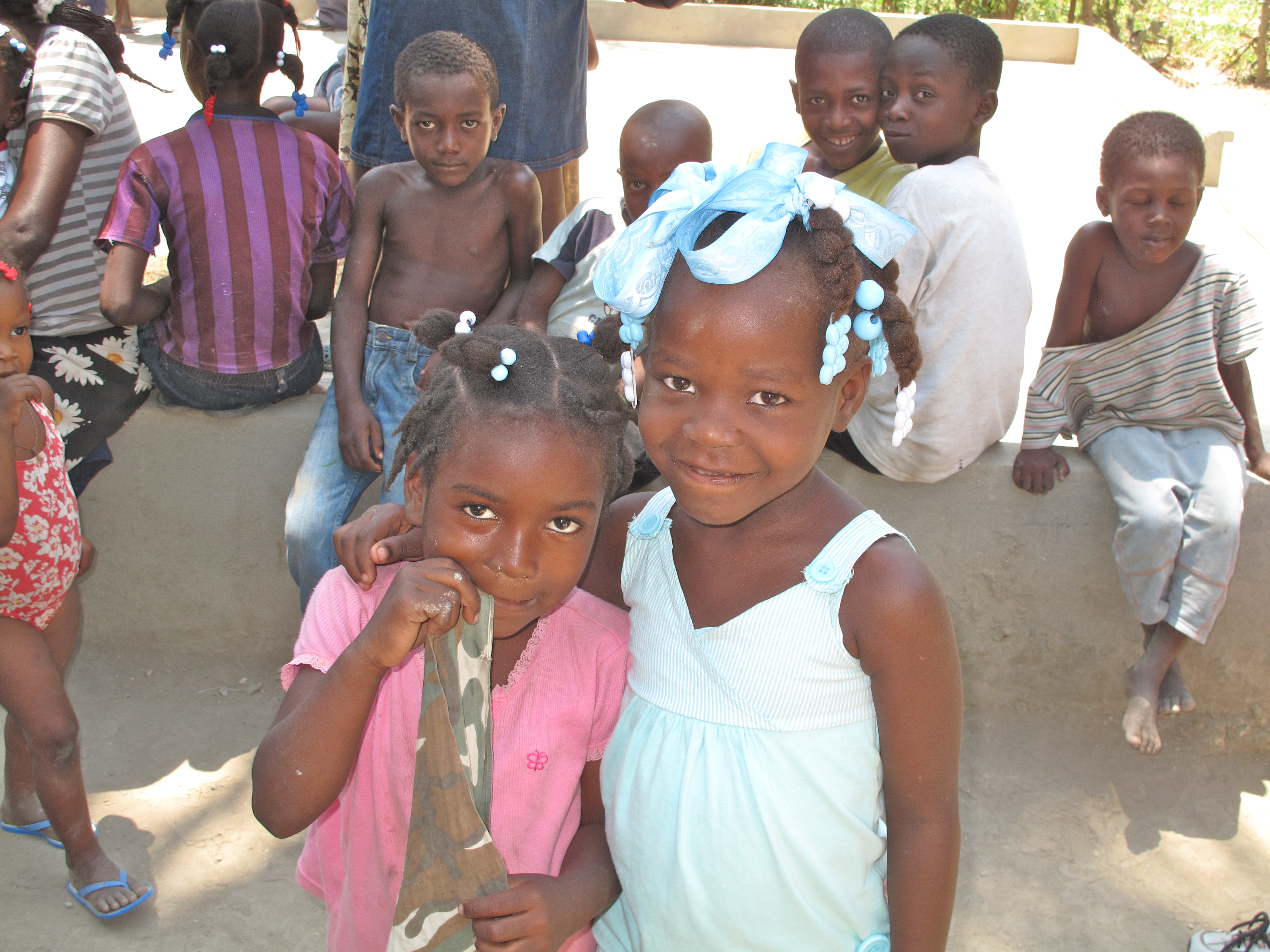
A thin grandmother wearing a clean and colorful dress stood, in shoes, with two granddaughters flanking her. I was surprised to note that the old farm woman didn’t smell of sweat and mud. Both girls had ribbons braided into their hair and tied in bows. They wore clean Sunday-go-to-church dresses, and they both wore sandals.

“Dis one, she won’t eat, and da other is always tired.”

Intestinal parasites in both; medicine for the two of them.

A six year old boy, on his mother’s lap, wore a suit – dark slacks and matching jacket over a crisp white shirt. His shoes shined like black mirrors. He had a congenital problem that meant he couldn’t control his bowels. “Dey tease him at school,” his mother worried. “He maybe will drop out of school. Den how he get a good job?”

A teenaged girl stood mute by her mother’s side. She wore a clean dress of multi-colored flowers, and smelled of perfumed soap. Her face had no expression.

“She was in Port-au-Prince,” her mother nodded toward her, “when the earthquake hit. I brought her back here because she was so terrified to stay there. She lost her words.”

Lost her words?

“She hasn’t spoken since the earthquake.”

Luckily, we had a French-speaking counselor on our team.

After we’d listened, examined, then prescribed, they each smiled and thanked us effusively for the little we’d done.

“Merci, Doctor, merci.”

One middle-aged woman told me, “You are the first doctor I’ve ever seen.”

On our way back to the airport, weaving thru crowds of people who were barefoot again, incompletely covered by tattered clothes again, it was obvious to me that, while our medicines may have helped a few people for a few days, what the appreciative and classy people of Haiti really need is water which is separated from the sewage.

Real simple concept. Apparently, monumentally difficult in Haiti.

So maybe my colleague was right. The people are powerless to drink anything other than the contaminated water of Hades.

Ticking time bomb.

March 21, 2010

Dog Food Medicine

Filed under: Uncategorized — cbmosher @ 7:40 am

Pierre calls 911 for an ambulance every week or two during the warm months when he still pans for gold. More often during the lonely winter.

“Chest pain,” he’ll say the magic words. “Like a fart turned sideways.”

Just to seal it, he’ll often add “I can’t drive.”

We wouldn’t want him to. Not any time after eleven A.M. anyway. There are enough drunks on the roads during the night hours causing accidents; we don’t want the steel mining contraptions that fill his rusty Datsun clanging into each other as he drifts, occasionally, into the right lane, then yanks the car back onto its usual trajectory directly into oncoming traffic.

“We’re coming, Pierre,” we always reassure him.

It’s my job to bring the dog food.

Red lights flashing off the pine trees astride the road, siren wailing to warn any meandering deer, Joe, the hospital janitor, weaves around the hills and swoops us down, then up the gullies. Like a needle embroidering the landscape.

As the ambulance strains up the final grade to Pierre’s shack on the hill, transmission slipping, medical equipment sliding to the back of the vehicle, I pull a can opener from the Trauma Kit and start opening the first can. I’ve ruined a few pairs of pants from that splattered grease.

The instant we arrive at the junkyard that surrounds his shack, the ambulance is accosted by a half dozen raucous canines, no two of which look to be even the same species, let alone the same breed, but all of which are seriously mean and, we’re pretty sure, unvaccinated.

I roll down the window. A big, stinking breathed black-and-brown with thistle matted fur launches his front paws onto the door, almost reaching the window, snarling in a pitch that makes my ears ring.

“Ready?” I yell to Joe.

“Ready.”

I wind up, like back in Little League, and heave the can as far as possible from both ambulance and front door of the shack.

The howling, yelping, baying cacophony streaks after the can. We jump out, run to the back of the ambulance, yank out the gurney, and run for the shack.

“Got the Trauma Kit?” he asks me.

I streak back to the ambulance, grab the kit, then race back toward the shack. The black-and-brown sees me, and comes charging. We burst in, hauling the gurney and Trauma Kit, and slam the door behind us.

“What took ya so long?” he says from somewhere within the junkyard that is the inside of his shack. “My friends are saying nice things about me – I must be ready to die.”

The din of dogs is a muffled tornado beyond the thin walls. We can slow down now, and be methodical.

I check his blood pressure.

“Never mind that. Check my eyes. I don’t wanna go blind from that Immaculate Degeneration, like my brother.”

“I thought you had chest pain,” I retort.

“Yeah. It’s prob’ly from the cigars the doctor said I had.”

“You smoke?” I am surprised. “I thought you just chewed,” I try hard – in vain – not to look at the permanent brown streak of stained skin at the right corner of his mouth.

“Don’t smoke,” he mumbles. “Doctor said the X-ray showed cigars on my lungs.”

I listen to him breath, stethoscope at full distance. I don’t want to breath too deeply, that close to him.

“There’s some mucus in your lungs. You coughing it out?”

“Can’t. I can get down to my cough, but I can’t get under it. It’s stuck. Take me to the hospital.”

We will, of course. But by the time he’s strapped securely into the gurney and we’re ready, a dozen paws scrape furiously at the door. The incessant caterwauling has enveloped us.

I pull the second can from the Trauma Kit, open it, crack the door just enough, and heave again.

They all wheel and run after it. All but the black-and-brown. He stands there, snarling at me, saliva drooling from his black lips like tobacco juice from an old miner’s mouth. But then he, too, turns to chase the pack, sure of himself that he’ll get the biggest share.

We run for the ambulance, wheels bumping over the irregular earth and the scattered trash.

“Hey, slow down,” Pierre complains. “It feels like you done thrown me in the ore tumbler.”

We shove him in the back and lock the gurney in place. We just make it to our seats before the dogs come back looking for a fight.

“Don’t you feed your dogs?” Joe shouts back to Pierre once we’re safe inside.

The sound of dog claws scraping down the paint and steel of the vehicle reminds me of the blackboard in grade school.

“Sure I feed ‘em, “ he yells up to the driver. “I feed ‘em ambulance guys.”

And he chuckles all the way down the hill as our red light sweeps the pines that straddle the road.

January 26, 2010

We Have Met the N.M.E., and it is Us

Filed under: Uncategorized — cbmosher @ 6:46 am

Dear Stakeholders:

This memo is an effort at Consensus Building for the Rollout of our new Program to Entirely Eliminate Public Health Acronyms and Shibboleth Terminology (PEEPHAST).

A recent Gap Analysis of Public Health’s Capacity to communicate with our Partners showed that Lessons Learned have not developed into Best Practices as fully as we’d hoped in the Health Equity Plan. In fact, we’re getting considerable Push-Back about our terminology. This is causing pain in our Asset-Based Built Environment office.

In the interest of Transparency, the process to establish a Footprint for PEEPHAST will pick through the Low-Hanging Fruit from all the Silos we call Public Health programs.

A meeting of Stakeholders (who we hope, by meeting’s end will have become the Gatekeepers for PEEPHAST) has been scheduled at a place and time convenient to Staff. At the PEEPHAST meeting, we will Drill Down through the entire Skill Set in our Toolbox. Our Over-Arching goal is to find consensus that will make Champions for PEEPHAST of every one of you.

The agenda for the meeting is still under development, but it will be Robust, and there will be little time for Physical Activity Breaks. So please come prepared to work hard and remember: PEEPHAST for Public Health!

Note: consistent with our tradition of  Cultural Sensitivity in all areas, including the culinary, we have prepared two versions of this memo: one directed to Stakeholders, the other to vegetarians. Please pardon us in advance if you receive the wrong memo.

« Newer PostsOlder Posts »

Blog at WordPress.com.