Sex, Drugs, and Public Health

September 28, 2013

Estonia: The Museum

Filed under: Uncategorized — cbmosher @ 5:12 am

This entry on Sex, Drugs and Public Health documents impressions of Estonia from a recent trip.


Can’t travel to some new place without someone suggesting you visit one.  Walk through halls of stagnant air, staring at a series of inanimate displays whose significance is only marginally brought to life by reading a blurb plastered to the wall.  If you’re lucky, it’s in your native language.

But this one sounded different right from the start.

“Is to show, the KGB museum, how ve lived until only tventy years ago,” the guide says in her high school English.

Tiina had described some of that to me several times before.  She returned to Estonia in the early 70’s to see family members left behind when her mother grabbed her as a two year old and fled on foot, through Estonia, Latvia, Lithuania, Poland, Czechoslovakia, into Germany, escaping the invading Russians.

“Other Estonian expatriates warned me not to return – that the Russians would not allow me to leave again,” she’d told me.

This museum is on the top floor of the Viru Hotel in downtown Tallinn.  Our guide is a young woman in her 30’s, whose personal experience with the Russian occupation, given her age, would have been limited.  The Soviets left in 1991.  But a lot of scars remain.

“Ve go to a floor that doesn’t exist,” she twinkles her eyes, pushing the elevator button for the highest floor.

We get out to see just more rows of hotel rooms, standing like soldiers in innocent order.  She leads us to a staircase hidden behind a door, and up another level.

“Everyone is told, there is nah-sing up here.”

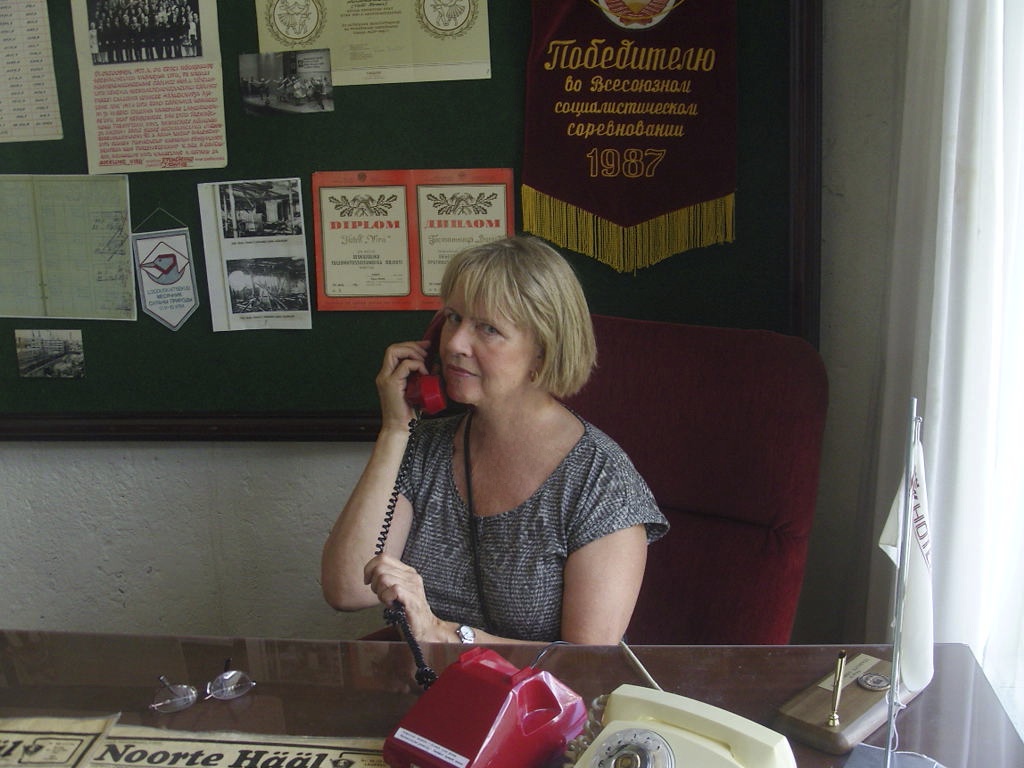
On that level, we find an office for the highest ranking Soviet official, the walls bedecked with photos of Gorbachov and Andropov, and with official proclamations.  Two phones are on the desk.  One red; one white.  Neither has a dialing plate.
 

SAMSUNG DIGITAL CAMERA


“Direct to Moscow, this line,” she points to the red.  “Into the spy room this one,” she indicates the other.

Down the hall is another door.  Estonian words on it are translated by the guide.

“Zhere is nah-sing behind zhis door.”

She churckles.  “Ve write zat to make fun of zee Soviets because, they always said zhat.  No sign on door in Soviet times.”

Inside are banks of archaic electronics.  Large radios occupy several of the spaces.  An old reel-to-reel tape recorder occupies one space.  Wires spiderweb the ceiling.  Headphones and ashtrays on a small metal desk were hastily abandoned in 1991.  Half smoked cigars included.  A white phone on the desk twins the one in the officer’s desk.

“If you vanted come to Estonia, you may stay only at zhis hotel.  Fifteen percent of the rooms in hotel were bugged with microphones and cameras.  Certain people are always assigned to one of zhose rooms.  Can you guess who?”


DSC_0299

“Spies.”

She laughs.  “Yes, I suppose.  If James Bond makes reservation, he gets bugged room.  Who else?”

We shrug.  Even Tiina.

“Journalists,” she tells us.  “Soviets vere very paranoid about reporters.  And also, Estonians who return from other countries.  Is anyone here Estonian from elsewhere?”

Tiina raises her hand.

“Did you ever come back in Soviet times?”

“Oh, yes,” Tiina acknowledged.

“Zhen, you stay in zhis hotel.”  It was not a question.

“Yes.  We did.  This hotel.”

“You get bugged room,” she picks up a set of headphones.

“We assumed that.  My family said that we only talk freely outdoors, in the park.”

“Yes,” the guide smiles.  “Everybody knows zhis KGB is here.  Is – vhat you call?  ‘bad secret’.  Bad kept secret.  Vunce, journalist comes into room, looks around and says to wife, ‘Look.  No sheets on the bed’.”

The guide smiles.  Pauses.  Continues.  “Zhen comes knock on door.  Zhey open.  Is maid wiz sheets.”

We chuckle.  Easy to chuckle now.


SAMSUNG DIGITAL CAMERA


“On every floor zhere is grandmother in chair by elevator.  Why, you tink?”

Tiina recalls.  “They marked down every move you make.  How long you’re in the room.  Who’s in room with you.  How long you’re gone.”

“Correct.  Zhey report everyzhing.  But in store, is very little food.  No toilet paper.  Is very hard in Soviet times.  So vhat you tink happens?”

Tiina again.  “We gave the grandmother gum and cigarettes, and then she sees nothing.”

“Correct.  You know zhis very well.  Know vhat else you can give which, like a great gift, is appreciated?  Plastic bags from Finland.  In zhose days, Estonians carry plastic bags like Gucci.”

We chuckle, uneasily.

“You vant taxi, vhat happens?”  She’s still looking at Tiina.

“Black taxi.  We only get the black taxi.”

“Yes.”  And tell group, vhy is zhat?”

“They only wanted outsiders to see certain parts.  Only the good parts, paved streets, clean houses.  So we’d think all of Estonia was like that.”

“Correct.  And never can you leave Tallinn.”

“We did.”

“Ja?!  You did?  In 1970’s?  Tell us how.”

“I came to see my grandmother.  She lived in Tartu.  They told us Tartu was closed.  ‘Closed?’  You can’t ‘close’ a city.”

“Soviets can,” the guide adds, urging Tiina to continue.

“ ‘Bullshit’ I said.  I came to see my grandmother.  She survived Siberia, but she wouldn’t survive old age.  I was going to see her.  One of my family here spoke perfect Russian.  He had us dress up like University students, and never speak.  Not even me.  Because my Estonian was different.  We got on a train and went to Tartu.”

“And?  No problems?”

“Some problems.  A Soviet officer came up to my husband, who was wearing a student’s cap, and began to speak to him.  Raul, our cousin, came running and took over.”

Carried by the emotion of her memories, Tiina lapses into Estonian.  The guide translates:

“Zhen, she says, returning, zee shoes were all muddy because zee streets of Tartu, streets of University city, not paved.  Zhis streets of mud is vhat the Soviets don’t vant you to see.”

“So,” Tiina resumed in English, “we had to take paper and wipe off the mud to get rid of that evidence before we got off the train in Tallinn.”

“But you not use toilet paper,” the guide added.

“No.  There was no toilet paper.  Not anywhere we went.  Except the hotel.”

“And zhis is vhy zhere is no pages in phone book, anyvhere you go, too,” the guide added.  “You have good stories,” she thanked Tiina.  “I use your stories to help ozher people understand how it vhas.”

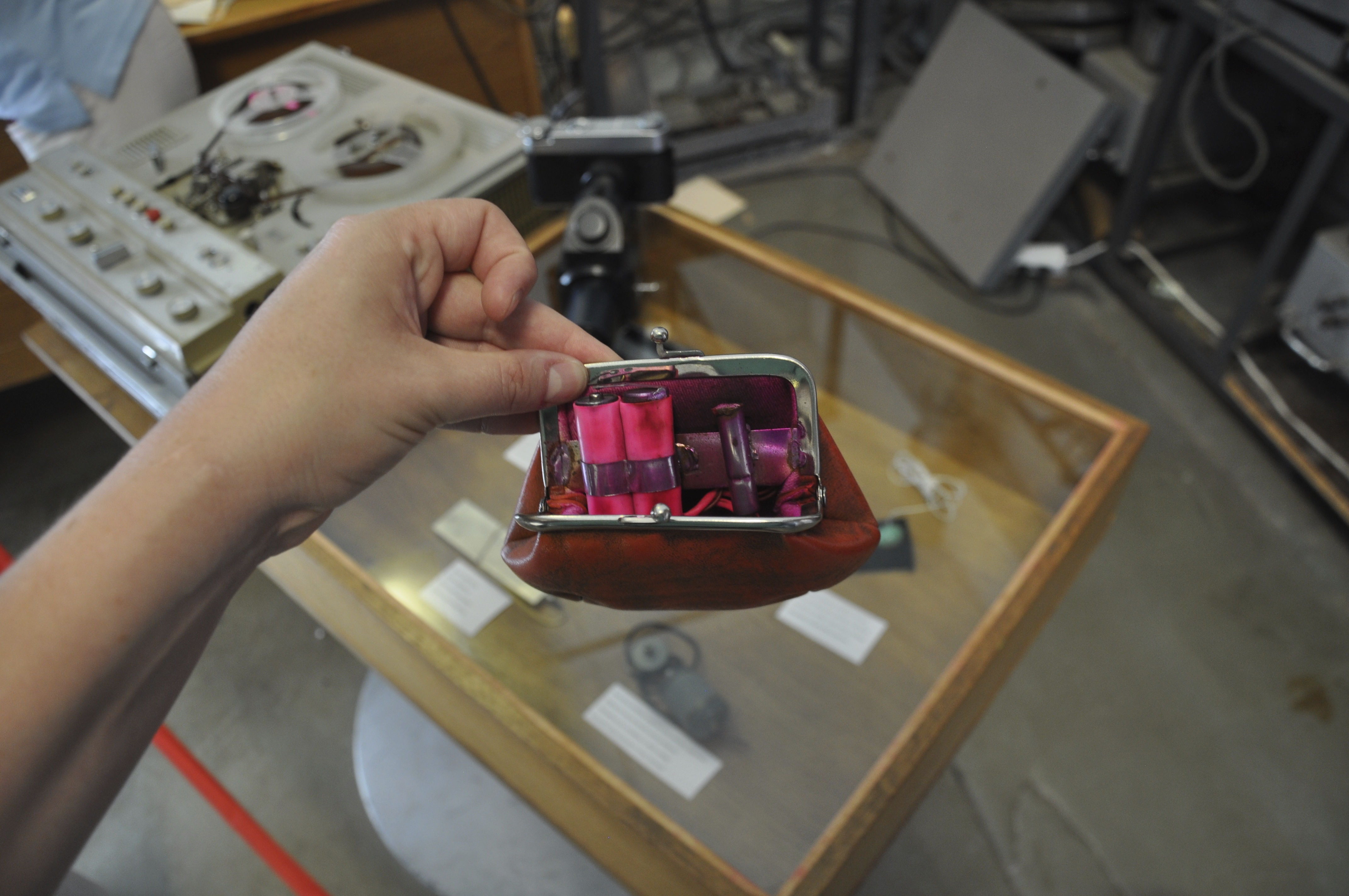
She picked up a small ladies’ pocket purse.  Held it up.  Snapped it open.  Inside was a small cylinder smeared red.

“Vhat is, you tink?”
 

DSC_0294


We all guessed wrong.

“Soviets vanted all hotel employees to be honest.” She ironied.  “Zhey put purse in room.  If employee opens to take money – because in zhose days rubles are vorth very little – zhis is dye.  Employee is covered in red dye.”

Even James Bond, I think, would find that way too hokey.

“So, the Russians are gone, now?” a Canadian tourist asks.

Our guide shakes her blonde head.  “Not gone.  Soviets are gone, but not Russians.  Twenty-five percent of people in Estonia now are Russian.  During Soviet times, many Russians came to Estonia to take all chobs.  In Soviet apartments, zhey lived.”

I’ve seen these, in every city.  Amid the beautiful old wooden homes and shops of the Estonians are concrete rectangles, built in the 1950’s and 60’s, already crumbling, paint peeling.  It’s easy to find the Soviet housing.

“And, the Russian language you must use in those days.  In schools, in business.  But now, since Independence, Estonian is our language.”

“Your English is very good,” the Canadian compliments her.

“Ja.  Estonian and English ve learn in schools now. At home only, it is different. There I speak Russian.  My mother and father they are from Smolensk.  But outside my home, I speak only Estonian and English. No more Russian we have.”

Just scars.  Healing scars.


September 19, 2013

Three Tallinns

Filed under: Uncategorized — cbmosher @ 2:05 am


To many of the tourists disgorged from cruise ships at Tallinn’s sadam (port), this city’s “Old Town” is Estonia.

But to the residents of the capital, most of whom live, work, and play in modern Tallinn’s towers of glass and chrome, sprawling malls, and department stores, Old Town is a tourist attraction, good for the economy, but a crowded place to be avoided. It is also, however, a source of pride as a spectacular monument to their history.

There are other reminders of their history, at the outskirts of the capital. But most Estonians might see those as a receding nightmare.

Think of semi-circles, facing the sea.

People have lived in the forests and bogs of Estonia’s interior for 10,000 years, archeologists document. Sometime around 1000 C.E. , some of them began construction of a city on the shore of the Baltic, surrounded by a wall for protection. From the mists of the forests, a verbal history condensed into legends which surrounded the city like its walls. Kalev, a giant skilled in making trees into buildings, built the city and is buried beneath its hill. His grieving widow carried hundreds of boulders to cover him and create Toompea hill over his grave.

Old town is northern Europe’s best preserved Medieval walled town. The teeming commerce in tourists within it has not erased the spectacular architecture that evolved from Kalev’s fortress, from the occupation by German crusaders, then German merchants of the Hanseatic League, then Danish ownership, then Swedish overlordship.

3440904513_43cbe30e29

Grown up outside the walls is modern Tallinn, careening forward to not just join, but, perhaps, to lead twenty-first century Europe. Their across-the-water neighbor, Finland, has assisted from the moment Soviet occupation was driven from the country by the “Singing Revolution” in 1991. They invested early in the city with a major department store and since with electronics, plastics, and wood products.

Deep into the digital revolution, Estonians have created free WiFi countrywide, a national network of cell phone connectivity facilitated by the flat topography, and the invention of Skype. They provide their citizens free public transportation and Scandinavian style Health Care.

DSC_0883
But lurking gloomily beyond these two Tallinns are the rectangular cement structures the Soviets call “apartments” which were constructed during the occupation from 1944 to 1991. Architecturally contemptuous of the city, they are the hub of what has grown to house 25% of Estonia’s current population: Russians.

SAMSUNG DIGITAL CAMERA

The Estonians demonstrate much more tolerance toward their former occupiers, jailers, and torturers than the Soviets manifested against the inhabitants of the country. The Russians were not expelled, and certainly not exiled to Siberia, but are now incorporated into the society. They must, however, use the Estonian language for commerce.

You can feel how these powerfully different social forces do not just co-exist – they have intermingled to form modern Tallinn.

Tomorrow we begin our exploration of the country’s interior. We’ll see how well these same forces have consolidated into a modern Estonia.

May 20, 2013

Carville

Filed under: Uncategorized — cbmosher @ 3:53 am

That deep into Louisiana, the air you breathe is liquid insects. The humid chittering slimes your skin. And after a while, you forget your vibrating eardrums, to relinquish yourself to the incessant vibrato that cocoons you everywhere.

You walk slowly across a lawn beneath the dripping oaks. The hanging moss whispers over your hair. Grass sprawls everywhere. You see only two man-made things: a rusting horse drawn harrow that’s been a lawn decoration for decades, and plantation-era whitewashed buildings to the left, the right, and straight ahead, all staring at each other with the blank look of sphinxes.

You came to see Ghosts, but they hide.

Across the road somewhere is a levee. Which is some kind of dike or water filled gully in reality, but in the languid music of the South, is a mythical icon. Maybe you’ll go see it some afternoon.

You stare at the whitewashed sphinxes: if the Ghosts won’t come out, you’re going in.

“Are you Dr. Mosher? They tol’ us you’d be comin’. Welcome to Carville. Ah’m going’ to ophthalmology clinic. Come along.”

And you follow her white coat as she leads you down corridors of squeaky wood past dozens of silent doors. You are girded, expecting to be startled by Apparitions around each corner. But each turn just reveals another silent corridor.

“Here we are,” she announces at just another door. She opens it. She in her long white coat and you in your sweat-impregnated shirt enter. The room is quiet and, like everything else, white. People in long white coats murmur greetings.

Finally. The Ghosts.

Three patients sit, awaiting exams, silent. You don’t want to stare, but can’t help it. Not as dramatic as you’d thought, their faces are pale. Their skin is lumpy, immobile and tight. Like masks. You realize how much we depend on that facial skin to show expression. Their lips are thin, stretched taut.

Lastly, you look at their noses. Noses are meant to cover the nares – the dark openings which, paradoxically, are necessary for life yet strike horror if visible. Only one of them has lost his nose architecture. The cartilage has collapsed and his nose caved into his face. His nares flare and contract with each breath. The pink inside of his nose pulses like a reptile’s throat.

“With this disease,” the woman in white begins, “the patients lose sensation. Even on their corneas. So if they get a speck of dust in their eye,” she pulls an ophthalmoscope from her pocket, “or even just an ingrown eyelash, it can scratch and ruin the cornea and there’s no pain to warn you.”

She smiles at a patient as if recognizing a friend, murmurs some comforting words, then begins the exploration of his eyes with her ‘scope.
You watch to see if she touches him – or if she skillfully avoids skin contact without being insulting. You see his hands politely cradled in his lap. Stubby, shortened fingers.

She examines all three, scribbles in their charts, explains a couple of things to you, but doesn’t offer to let you do an exam.

And she doesn’t touch.

They shuffle out of the clinic, into the silent corridors. You haven’t heard one word – one sound from them.

“Come with me to the lab,” she smiles. “We use armadillos.”

Occasional windows in the corridors reveal what you knew they would: deep emerald of grass, the swaying brown of Spanish moss, a pale blue Louisiana sky. If the windows were open, you know what you’d hear.

Then, one window is different. A half dozen people shuffle across the grass moving gradually in the same direction. Their clothes are pastel variants of colors which all feel white.

“It’s lunch time,” your guide explains.

You pass an open door.

“Oh!” your guide stops suddenly. “Let me show you this.”

Inside the room of the open door are many tables at waist height. Papers scattered over all of them. You see a printing press in the corner.

“This is where we write and print ‘The Star’,” she sweeps the room with her right arm. “It goes all over the world to tell people about the disease and our work here. The residents themselves produce it.”

Her face, all its muscles working in perfect harmony, beams.

She leaves the door open while we continue down the corridor.

Behind a door like any of the others, there is sound and movement. The lab has more activity than you’ve seen all morning.

“This bacteria grows at low temperatures,” she explains as you pass cages of armadillos. “It can’t survive at ninety-eight point six, unlike all other human pathogens. That’s why it never goes deep – just the skin. So to study it, we need a lab animal with cool soft tissue.”

She picks up an armadillo as someone would a pet rabbit. It curls into a bowling ball in her hand.

“His foot pad is exactly the right temperature. We grow our cultures of the Mycobacterium there. Now, we’ve got – for the first time in human history – an antibiotic that seems to work.”

She replaces the armadillo in its cage, and you observe: “Maybe someday Carville will be closed?”

She shakes her head slowly. Her moving hair actually makes noise.

“No. All the others may close, even Molokai, but the residents here, they don’t want to live outside. No one out there understands them. Even if they become non-contagious with the new antibiotics, they’ll always be treated as – well, outsiders,” she consciously avoids the obvious word. “They’ll die here,” her soft, pliable lips smile slightly. “This is their home,” her face muscles move to reveal her love for them. “But when they’re gone – when this generation dies off, that will be the end of Carville.”

You walk across the lawn again in the mid afternoon. The air buzzes and drips. You’re the only one visible on the century-old plantation. A car drifts slowly past on the road in the distance.

Maybe you’ll shuffle on over and find out what a levee is.

So you’ll have one thing, this afternoon, that you can understand.

September 30, 2012

Med School Culture Shock VIII (final)

Filed under: Uncategorized — cbmosher @ 3:50 am

VIII Home Stretch

Over the next three and a half years, although I studied and practiced and followed the Residents on rounds in the hospitals like everyone else, something was changing in how I viewed Medicine. My senior year, I spent three months in a clinic in South America.

“Why down there?” John asked. “You wanna be Dr. Schweitzer instead of Dr. Kildare?”

“Diagnosticians need to know Tropical Diseases, too,” was the best explanation I could mount.

I applied for Internship in California.

“Why California?” John asked again. “We have plenty of good hospitals here.”

That was a little harder to answer. The best I could come up with was:

“The Times, They are a’Changin’.”

September 17, 2012

Med School Culture Shock VII

Filed under: Uncategorized — cbmosher @ 3:55 am

VII Into the Real

I signed up for a class on writing, once a week downtown. If it ate into my studies, I could drop out. Meanwhile, I was doing something other than Med School. A diversion. I was unaware that another diversion had already been planned into the Med School curriculum.

A little man in a wool suit and a bow tie took the microphone.

“I’m Dr. Bottie,” he began. “Welcome to Preventive Medicine.”

No one even tried to muffle their groans.

“I know you aren’t all that interested in Preventive Medicine right now…”

… Snickers and snorts …

“… but it’s an important branch of Medicine.”

Guffaws …

“And to start the class off, we’ll be doing a field trip. The buses will be here Friday at this time. It’s not a vacation, so dress like professionals,” he warned us, providing a little insight into past field trips. “And no smoking on the bus.”

Hand up.

“Yes?”

“Where will we be going?”

He smiled with his thin little lips. “Harlem.”

I was a little nervous about the field trip, and I could tell, by the snippets of conversation, that I wasn’t alone.

“My parents don’t have insurance on me for death by gunshot. Make it look like an accident, OK?”

“Never been this far north in Manhattan before. Does Santa Claus live in Harlem?”

Out the bus’s left side windows, Central Park’s expanse of grass flashed my memory to my father’s farm, where he had once held a Civil Defense drill: dozens of people lying across the big lawn, pretending to have been burned by the Atomic Bomb. They tried to convince me it was a fun afternoon. Mushroom cloud: what fun.

So I forced my mind to conjure, instead, a grassy hillside from my long ago bicycle summers: where I lay back in a meadow like Central Park’s to look down onto cornfields; where I was immersed in the bizzing of insects hidden in the grass; where I watched crows slowly circle in the warm blue above me on an afternoon that felt like forever and was light years from this New York Med School craziness; where a puff of breeze had brought me the perfume of chlorophyll, late flowers, and just a hint of cow poop.

“Graze around me, cows,” I said aloud.

And the cadence of the bus’s tires fell into the rhythm of Grazin in the grass is a gas, can you dig it?

But, unlike that forever afternoon, Central Park abandoned us at 110th Street. Brick apartment buildings gave way to empty lots and century-old tenements. The faces of the pedestrians outside changed color.

We followed Dr. Bowtie off the bus.

“These people have invited you into their homes,” his eyes swept across all of us. “Be respectful.”

“Homes? These are slums,” Dolen sneered.

“Disrespectful,” Ralph observed.

Dolen snorted.

Then Ralph added, “unprofessional.”

“Yeah, go back to where you came from Weirdo. You don’t belong in New York.”

We followed Dr. Bowtie into a dank hallway, then climbed three flights of decaying stairs which creaked, threatening to decompose with each step. We waited while the Doctor knocked on a door.

A black woman, small child on her hip, opened up.\

“Mrs. Moore, these are the students. Thank you for letting us in.”\

“Yo’ welcome, Doctor. Ah jus’ got back from da Urgency Room. My boy done got his finger bit off.”\

“Bit off?” Bowtie sought clarification as we squeezed into her dark apartment. Three mattresses on a floor of peeling linoleum. Trash heaped up in the corners. Filthy windows admitting little light.

“Grayson!” she called.

A boy, maybe four years old ran over to her and grabbed her skirt with his unbandaged hand. He peered up at us in fear. The rest of us stepped back slowly, trying to dissolve our white faces into the shadows.

All except Ralph. He squatted down to Grayson’s level.

“Hi,” he smiled at the boy. “I’m Ralph. What’s wrong with your hand?”

The boy held up his white bandage.

“Did you hurt your finger?” Ralph continued, softly, his voice a pitch higher than normal.

“It bit me,” the boy mumbled.

“Oh, I’m sorry,” Ralph soothed him. “Who bit you?”

“Da rat.”

“Rat?” Ralph’s voice betrayed surprise.

“Las’ nite. I was sleepin’.”

“Oh. I see. Where do you sleep? Can you show me?”

And Grayson let go of his mother to run over to one of the mattresses, stand beside it proudly, and declare:
“This one mine.”

Ralph walked over, squatted down to look closer at the mattress on the floor. “What a nice mattress you have,” he praised the boy. “Do you help your mother by making the bed?”

“Ain’t no bed,” Grayson educated him. “It’s a mattress.”

Later, as we boarded the bus, I heard Dolen sing song as he passed Ralph. “What a nice mattress.” Then his voice switched to its familiar sneer. “Fairy!”

I made a point of catching up to Ralph in the corridor of the school.

“Sorry about what Dolen said.”

He shrugged. “That’s his problem. I feel sorry for him.”

“You do? You’re the only one in the class, then.”

“Really? That’s sad.”

“Where are you from?” I took the most direct path to the answer of this human enigma.

“A little town near San Francisco. Why?”

“You seem more – – ah, – – – relaxed. Doing stuff other than studying. As if you were – – – I don’t know – – -.”

“Mellow?” he offered. “More laid back?”

“I don’t know what that means.”

That smile again.

“What’s your specialty gonna be?” I veered the discussion for my own comfort. “Preventive Medicine?”

“Pediatrics. But now that you mention it, Peds is pretty close to Preventive Medicine. You?”

“Internal Medicine,” I fear I may have puffed out my chest. “I’m gonna be a Diagnostician. A Detective. Preventive Medicine’s definitely not for me.”

“Uh huh.”

“I hate bowties.” I braced for an argument.

“Good. Do what feels right for you. That way, you’ll be really into it. But, for me, I’d rather prevent illness than clean up after it.”

Shock may be the most accurate explanation for why, in spite of what was a clear opening for obvious and easy rebuttal, I was briefly speechless. The whole purpose, after all, of going thru the torture of Med School and becoming a Doc is to treat sick people. Well people don’t need physicians. When I did respond, it wasn’t too clever.

“Bullshit,” I said.

Smile to laugh to smile again. “You ever see a kid with a finger bitten off by a rat before?”

I held my hands out, palms up.

“Me neither. Now, what was the cause, the etiology of that – – – disease?”

“Rat,” I smirked.

“Nope. It was,” he paused – – – “Poverty. Wouldn’t happen in our homes, huh?”

“Oh, I get it. You’re gonna cure Poverty.” I lost control of my sarcasm.

“No,” he spoke quietly, gently. “Poverty – – – AND War.”

“Ah HA! ” I exhaled my satisfaction at finally fitting one piece of this puzzle neatly into its vacancy. “That’s why you’re against this war!”

He shook his head. “Against all War. It’s just logical. Can’t imagine any physician thinking otherwise. Well, gotta go.”

« Newer PostsOlder Posts »

Blog at WordPress.com.